Warehouses and manufacturing facilities constantly run into the same problem: too much inventory, not enough floor space, and retrieval processes that eat more time than they should.
Shelving systems get taller, aisles get narrower, and workers spend increasing amounts of time walking to find parts – none of which actually solves the underlying issue.
A different approach has been gaining ground across distribution centers, manufacturers, and smaller operations alike. Rather than expanding outward, these facilities are going vertical.
What a VLM Machine Actually Does
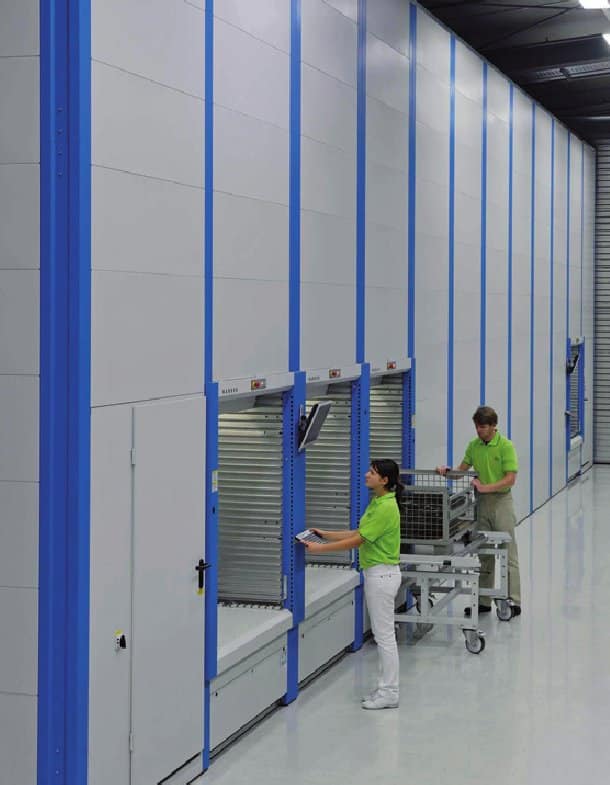
A VLM machine – short for Vertical Lift Module – is an enclosed automated storage and retrieval system that uses the full ceiling height of a facility to store inventory on trays arranged vertically.
When an operator requests an item, the system’s internal extractor automatically retrieves the correct tray and delivers it to an ergonomic access point at working height. The operator picks the item, confirms the transaction, and the tray is returned to its position.
VLMs vary in height depending on facility specifications, with some units reaching 50 feet or more. Software controls the system, tracks every item’s location, and in many configurations integrates directly with a warehouse management system or ERP platform.
The Space Argument
One of the clearest advantages of a VLM is what it does to floor space. Traditional racking and shelving require aisles wide enough for workers or forklifts to pass through. Multiply that across a full warehouse and a significant portion of the square footage is doing nothing but providing access paths.
A vertical lift module consolidates the same inventory into a fraction of the footprint. Because the storage happens inside an enclosed unit rather than across open shelving, there are no access aisles to maintain.
The floor space that was previously dedicated to shelving and navigation becomes available for other uses – additional workstations, production equipment, or staging areas.
Facilities that have switched from conventional shelving to VLMs commonly report floor space reductions in the range of 85 percent for the same stored inventory volume. The ceiling height that was previously going to waste becomes the storage medium instead.
This matters especially for operations in urban areas, leased facilities, or any context where square footage comes at a premium.
Workflow and Picking Efficiency

Beyond space, the operational benefits come down to how items are retrieved. In a conventional shelving setup, the worker travels to the inventory. In a VLM setup, the inventory comes to the worker.
That shift has compounding effects on a picking operation:
- Reduced travel time. Workers stay at or near the access point rather than walking aisles. In high-volume operations, this alone can recover hours of productive time per shift.
- Fewer errors. The system can display pick-to-light indicators or quantity prompts on a screen at the access point, reducing the chance of a worker pulling the wrong item or quantity.
- Less physical strain. Items arrive at an ergonomic height. Workers aren’t bending to floor-level bins or climbing for elevated shelves, which reduces fatigue over the course of a shift.
Picking speed improvements of 2x to 3x over manual shelving operations are frequently cited by manufacturers and distributors who have made the switch, with some high-density operations seeing even larger gains.
Inventory Control
Conventional open shelving creates a persistent inventory accuracy problem. Items get misplaced, counts drift between physical audits, and workers occasionally pull from the wrong location.
A VLM addresses this through the software layer. Every transaction – put-away, pick, replenishment – is logged automatically.
This has downstream effects on the broader operation:
- Reorder points can be set within the software so the system flags low-stock conditions automatically
- Shrinkage and unexplained inventory loss become easier to identify because every movement is recorded
- Cycle counts can be conducted without shutting down operations, since the system tracks changes continuously
For operations that carry high-value parts or components where stock accuracy directly affects production or order fulfillment, this level of control is difficult to replicate with open shelving, regardless of how disciplined the team is.
Who It Works For
VLMs aren’t exclusively the domain of large distribution centers. Smaller operations with the right inventory profile benefit just as much – sometimes more, since the proportional impact on floor space and labor is larger in a compact facility.
Manufacturing environments are a particularly strong fit. Spare parts, tooling, fasteners, and components often come in a wide range of sizes and are accessed frequently but unpredictably. A VLM handles mixed SKU profiles well and eliminates the sprawl that tends to develop when parts storage is managed with open shelving.
Pharmaceutical, electronics, and aerospace facilities also use VLMs extensively because the enclosed design provides a controlled environment for sensitive inventory and reduces the risk of damage from exposure or handling.
The deciding factor is usually inventory profile and retrieval frequency. Operations that store a large number of different items and retrieve them often throughout the day get the most return from the investment.
Implementation Considerations
Adding a VLM to an existing facility isn’t a drop-in process, but it’s more straightforward than most large capital equipment installations. The primary requirements are ceiling height – most units need a minimum of around 15 feet, though this varies by manufacturer – and a concrete floor capable of supporting the unit’s loaded weight.
Integration with existing software systems is worth evaluating early. Most modern VLMs can connect to warehouse management systems and ERP platforms, but the specifics of that integration affect how much manual data entry is eliminated versus how much parallel tracking remains.
Lead time, installation, and training typically run a few weeks from delivery. Most facilities are fully operational with the new system within a month of installation.