

You come home to find the front door ajar, your TV gone, and drawers pulled out. You call the police and tell them you’ve been robbed.
The officer gently corrects you: “This is a burglary, not a robbery”. That’s not just a vocabulary lesson.
Getting the label wrong changes how charges are filed, how a defense is built, and how many years end up on the table.
Burglary and robbery are two distinct crimes with different legal elements, different victim requirements, and very different sentencing ranges.
Theft is the third term that gets pulled into the mix, and it belongs in this conversation, too.
This guide covers all three, including when a single incident can result in both burglary and robbery charges at the same time.
What is Burglary?

Burglary is unlawful entry into a structure with the intent to commit a crime inside.
That’s it.
You don’t have to break anything, steal anything, or even complete whatever you planned to do. The entry plus the intent is enough for the charge to stick.
Under the old common law, burglary required it to occur at night and involved forcible entry. However, modern state statutes have removed both of these requirements.
Today, simply walking through an unlocked door during the day can qualify as burglary. Also, looking through a window with the intent to steal counts as a Mens Rea.
What matters is whether you had criminal intent when you crossed the threshold.
What qualifies as a “structure” also varies by state, but generally includes homes, businesses, garages, sheds, and, in some jurisdictions, vehicles.
The intent must exist at the moment of entry. If you enter a building lawfully (as a guest at a party, say) and only later decide to steal something, most states would not charge that as burglary.
One more thing worth noting: a victim does not have to be present. Burglary most commonly happens when no one is home. That’s part of what makes it distinct from robbery.
A concrete example: someone walks through an unlocked back door intending to steal electronics, hears the alarm go off, and runs out empty-handed. That’s still burglary.
The law looks at intent at the time of entry, not at what was actually taken.
What is Robbery?

Robbery is taking property directly from a person through force, threat, or intimidation.
Three things have to line up: a victim must be present, the property must be taken from their person or immediate control, and force or fear must be used to do it.
Robbery does not require a building. It can happen on a sidewalk, in a parking garage, at an ATM, anywhere. And the force doesn’t have to be physical. A verbal threat is enough.
Someone putting their hand in their jacket pocket to imply they have a weapon, even if they don’t, satisfies the fear element under most state laws.
Burglary vs Robbery: The Key Differences at A Glance
|
Element |
Burglary |
Robbery |
|
Must the victim be present? |
No |
Yes |
|
Building or structure required? |
Yes |
No |
|
Force or threat required? |
No |
Yes |
|
Must theft be completed? |
No, intent is enough |
Almost always |
|
FBI crime classification |
Property crime |
Violent crime |
|
Can it happen in a public place? |
No |
Yes |
The single most practical separator for everyday understanding is the victim. If no one was there and the property is missing, it’s almost certainly a burglary.
If someone was physically confronted and had something taken from them by force or fear, it’s robbery.
Degrees of Burglary
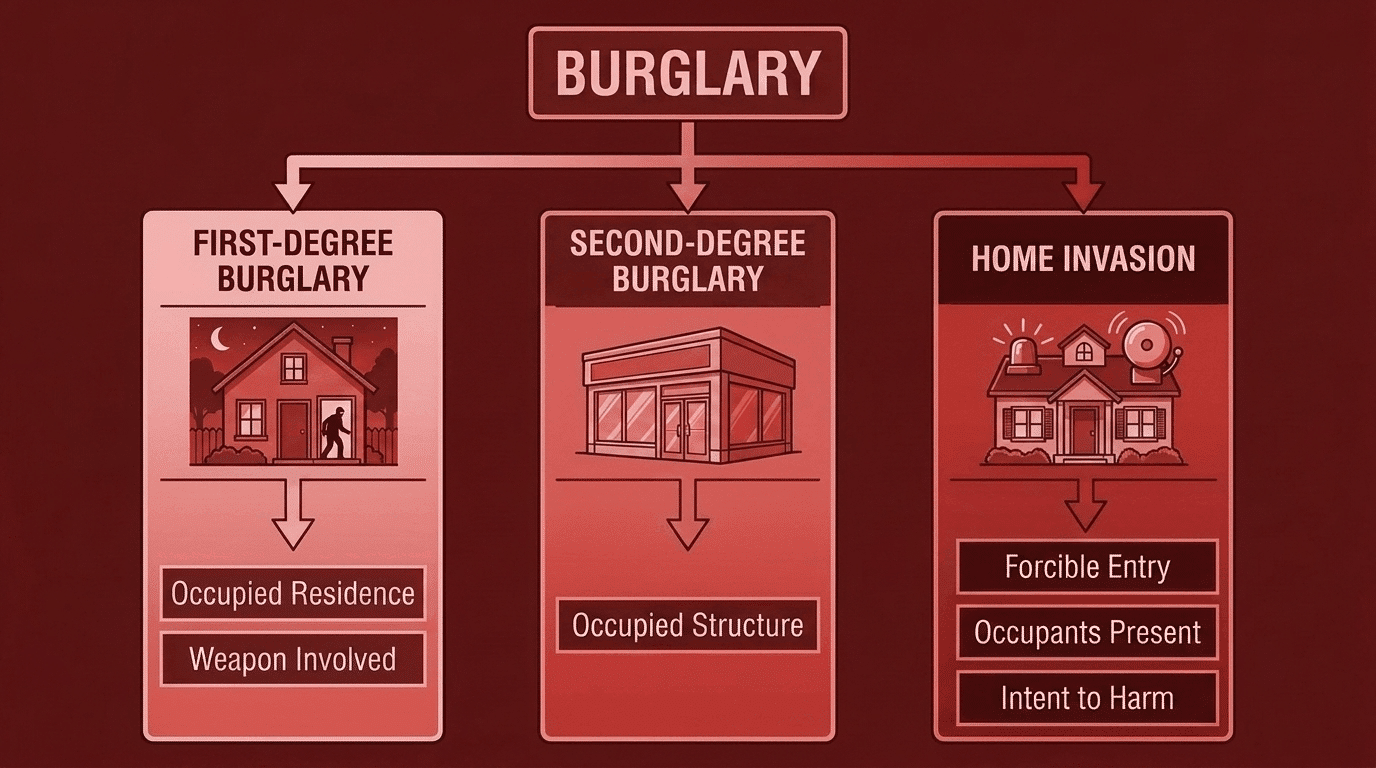
Most states break burglary into at least two degrees. Some, like Indiana, use up to five.
The factors that drive the degree up are generally: whether the structure was occupied, whether it was a residence, and whether a weapon was involved.
- First-degree burglary: occupied residence. Most serious version. Typically, 10 to 25 years, depending on the state.
- Second-degree burglary: unoccupied structure or commercial property. Moderate felony, typically 2 to 10 years.
- Home invasion: Several states treat this as a distinct charge from standard residential burglary, with even harsher penalties in those jurisdictions.
Whether someone was home when the burglary occurred is often the single biggest factor in where a charge lands on the degree scale.
Degrees of Robbery

- Simple robbery: force or threat, no weapon. Felony in all 50 states. Typical range: 2 to 15 years.
- Armed or aggravated robbery: weapon displayed or used, victim injured, or victim is elderly or disabled, depending on state law. Typical range: 5 years to life.
- Federal bank robbery (Hobbs Act): up to 20 years base; elevated with violence or weapons.
One nuance worth knowing: in many states, using a fake gun or an unloaded weapon still triggers armed robbery charges.
The legal question is whether the victim had a reasonable belief that the threat was real.
Most of the time, they did.
Can You Be Charged with Both Burglary and Robbery?
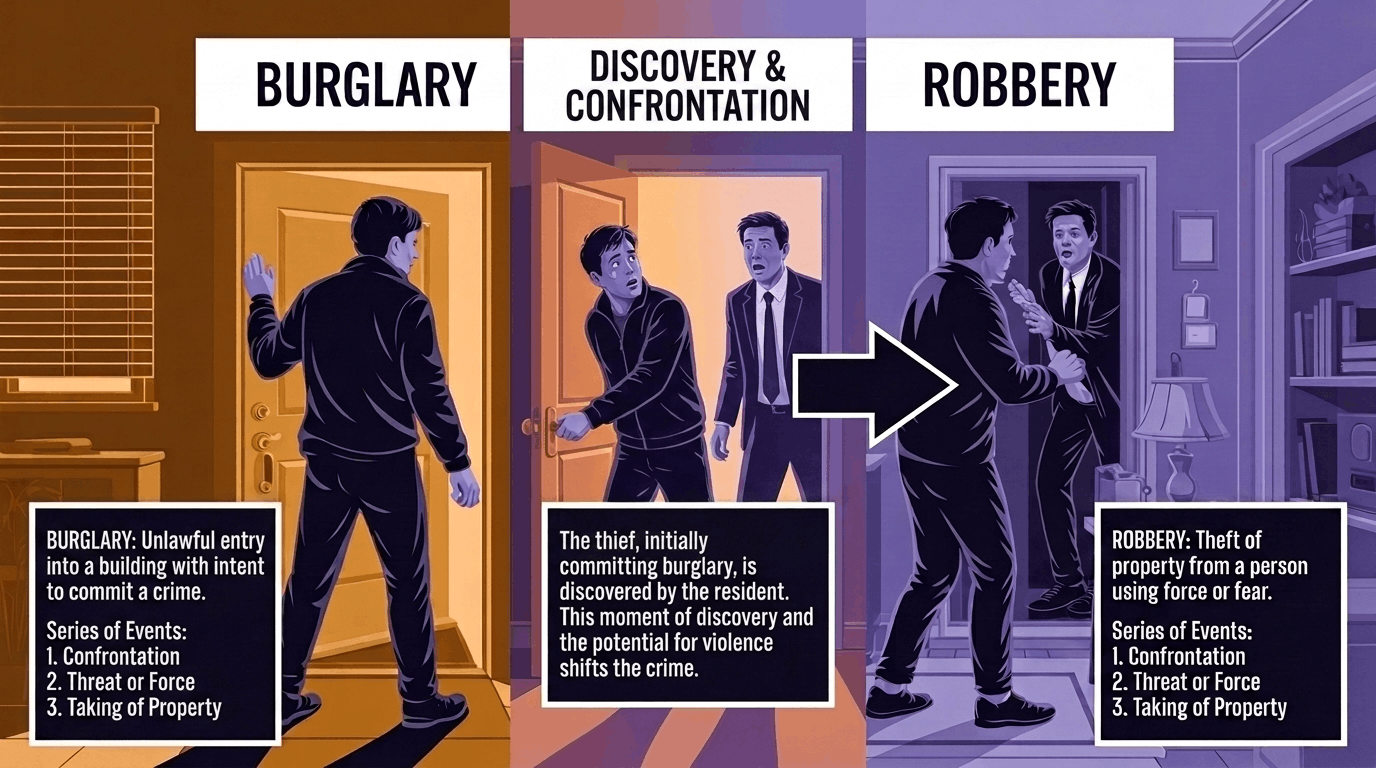
Yes, and it happens more than people expect.
These charges are not mutually exclusive. They address different elements of the same criminal event.
The moment a burglar confronts an occupant and uses force or threats to take property, the burglary charge no longer goes away. The robbery charge gets added on top of it.
Prosecutors can and do file both.
That compounds sentencing exposure significantly, because each charge carries its own penalty range, and they can run consecutively rather than concurrently, depending on the federaljurisdiction and the judge.
From a defense standpoint, facing both charges means an attorney must attack the specific elements of each charge separately.
For the robbery charge, they may challenge whether force or fear was actually used, or whether the property was truly taken from the victim’s immediate presence.
For the burglary charge, they may challenge whether the defendant had criminal intent at the time of entry. Undermining one doesn’t automatically undermine the other.
Defendants and victims alike often assume it’s one charge or the other. It isn’t always.
What Victims Should Know: How To Report Your Crime Accurately

Accurate reporting matters more than people realize. It affects how US police prioritize the case, which charges are filed, what your insurance claim looks like, and which investigative resources are allocated.
A few clear rules:
- If no one was home and property is missing, you were burglarized. Tell the officer that.
- If someone physically confronted you, used force or threats, and took something from you directly, you were robbed.
- When you speak to police, describe what happened factually: whether anyone was present, whether force or threats were used, and how the person gained access to the property.
Getting this right from the start helps prosecutors file the right charges and builds a stronger case. The wrong label on the initial report can create complications down the line.
The Bottom Line
The confusion between burglary and robbery isn’t harmless. It changes which charges are filed, which defenses apply, and how serious the sentencing exposure is.
One is a property crime. The other is a violent crime. That gap shapes everything: the immediate criminal process, long-term housing and employment prospects, civil rights implications, and the weight of a felony record.
If you or someone you know is facing either charge, the first thing a defense attorney examines is whether the prosecution can actually prove every specific element.
Each one has to be established beyond a reasonable doubt. That’s a harder bar than most people going into it expect.
Frequently Asked Questions
What is the Difference Between Robbery and Theft?
Theft is taking property without consent and without force. Robbery adds force or fear plus a present victim, making it a violent crime with far higher penalties.
Is Carjacking Robbery or Burglary?
Robbery. Property is taken from a person by force. No building entry is involved.
What Happens if Someone is Home During a Burglary?
The charge typically escalates to first-degree burglary. If the intruder uses force or threats against the occupant, a separate robbery charge can also be filed.