
Criminal law doesn’t just ask what you did. It asks what you were thinking when you did it.
Two people can commit the same physical act and face completely different charges depending on their state of mind at the time. One goes home. One faces felony charges.
If you’ve ever wondered why intent keeps coming up in criminal cases, or why “I didn’t mean to” sometimes works as a legal defense and sometimes doesn’t, understanding mens rea meaning in full is the place to start.
What Does Mens Rea Mean?
Mens rea (pronounced menz ray-uh) is Latin for “guilty mind.”
The phrase comes from a foundational legal maxim: actus non facit reum nisi mens sit rea, which translates to “the act is not culpable unless the mind is guilty.”
Legal historians trace this principle back nearly 1,000 years in common law. It’s still the backbone of how criminal liability works today.
In practical terms, the mens rea meaning in criminal law comes down to this: it’s the mental state a defendant must have had when committing a crime. It’s what separates a deliberate act from an accident.
The prosecution in most criminal cases has to prove this mental state beyond a reasonable doubt, alongside the physical act itself.
Mens Rea vs Actus Reus: Why Both Have to be Proven
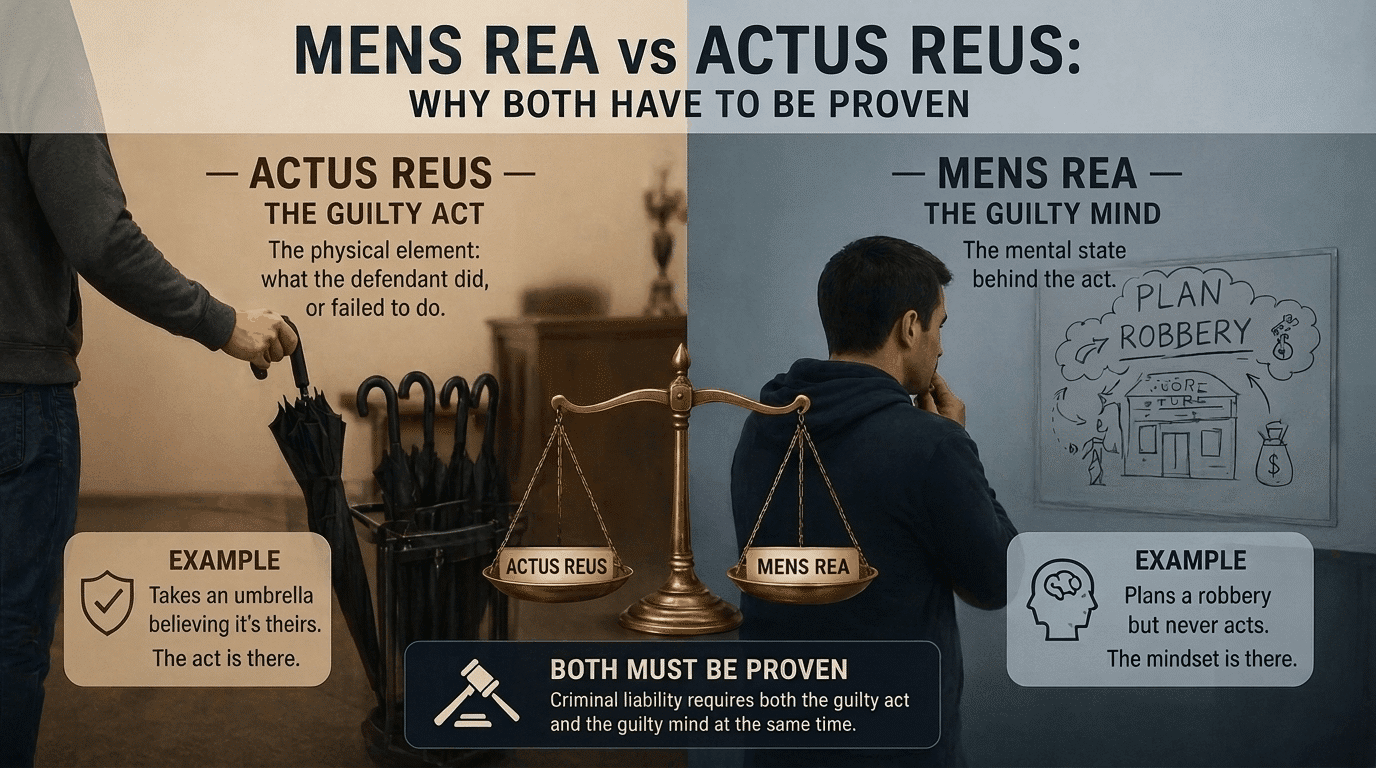
Most people know that to convict someone of a crime, the prosecution has to prove they did something wrong. What’s less obvious is that “doing something wrong” has two separate components, and both have to be present.
Actus reus is the “guilty act.” It’s the physical element: what the defendant did, or in some cases, what they failed to do when they had a legal duty to act. Mens rea is the “guilty mind.” It’s the mental state behind the act.
Criminal liability generally requires both, and they have to coincide at the same time.
Here’s why that matters in practice. Say someone picks up an umbrella from a rack on the way out of a restaurant, genuinely believing it’s theirs.
The actus reus is there: they took someone else’s property. But there’s no mens rea. They had no intent to steal. That’s not theft under most legal frameworks.
Flip it around. Someone spends a week planning to rob a store but never follows through. There’s clearly a criminal mindset, but no actus reus yet. No completed crime.
This is why defense attorneys spend so much time on the question of what a defendant knew and when they knew it.
Dismantling the prosecution’s mens rea argument is often the most direct path to a not-guilty verdict.
The 4 Types of Mens Rea Under the Model Penal Code
Historically, courts used terms like “general intent” and “specific intent” to classify criminal mental states, which created a lot of confusion because those terms meant different things in different jurisdictions.
In the 1960s, the American Law Institute introduced the Model Penal Code (MPC), which gave mens rea a cleaner, more standardized framework of four clearly defined categories. Most states now follow this system.
The four types are ranked from most to least culpable, and that ranking directly affects which charges are filed and which sentences are handed down.
1. Purposely (highest Level)

The defendant consciously intended a specific outcome.
They planned it and wanted it to happen. Think of someone who stalks a victim, waits for the right moment, and commits an assault.
There’s a deliberate objective behind every step. Purposeful crimes carry the most serious penalties, including first-degree murder charges in homicide cases.
2. Knowingly

The defendant didn’t necessarily want a particular outcome, but they were practically certain it would happen and proceeded anyway.
Example: selling drugs to someone you know is a minor. The harm may not be the goal, but you know exactly what you’re doing and who you’re doing it to.
Courts often treat “knowingly” as a near equivalent of “purposely,” and many statutes group them together.
3. Recklessly

The defendant wasn’t aware of the risk they created, but a reasonable person in the same situation clearly would have been.
A caretaker who leaves a child unsupervised near a swimming pool may face negligence charges even without any intent to cause harm.
No malice, but a gross departure from the standard of care the law expects.
4. Negligently (lowest Level)

The defendant wasn’t aware of the risk they created, but a reasonable person in the same situation clearly would have been.
A caretaker who leaves a child unsupervised near a swimming pool may face negligence charges even without any intent to cause harm.
No malice, but a gross departure from the standard of care the law expects.
Motive vs Mens Rea: They’re Not the Same Thing

Motive is why someone did something. Mens rea is what they intended to do. They’re related but legally distinct, and only one of them is actually an element of most crimes.
Motive doesn’t have to be proven. It’s not part of the legal definition of most offenses. A person who commits theft to feed their family still has the mens rea for theft.
Their reason for doing it doesn’t negate the intent. Motive can come up at sentencing, where a judge considers circumstances and moral blameworthiness, but it doesn’t determine guilt.
A “good” motive doesn’t immunize someone from criminal liability either. Someone who commits fraud to fund a charity is still committing fraud.
The intent to deceive for financial gain was there, regardless of where the money went.
Prosecutors sometimes introduce motive as supporting evidence because it can make intent more plausible to a jury.
But it’s always supporting evidence, never a required element they have to prove.
When Mens Rea Doesn’t Apply: Strict Liability Crimes
Not all crimes require the prosecution to prove a mental state. A category of offenses called strict liability crimes punishes the act itself, regardless of what the defendant intended or knew.
Common examples include:
- Statutory rape: Even if the defendant genuinely and reasonably believed the victim was of legal age, that belief is not a defense. The prohibited act is enough.
- Selling alcohol to a minor: The seller’s intent or knowledge is beside the point. The sale happened, and that’s what the law looks at.
- Regulatory and traffic offenses: A driver who runs a red light because they were distracted doesn’t get to argue they didn’t mean to. The act is the offense.
The legal reasoning is straightforward: for certain categories of conduct, protecting the public outweighs requiring proof of intent.
That argument holds up better for a speeding ticket than for a serious criminal charge, which is why strict liability remains contested territory in legal scholarship.
How Prosecutors Actually Prove Mens Rea

Prosecutors can’t read minds, which means proving mental state is almost always done through circumstantial evidence. Common methods include:
- Statements by the defendant: a threatening voicemail, a text planning the route, and a confession to a friend the next day. Courts regularly admit all of it.
- The nature of the act itself: a carefully planned, targeted act looks very different to a jury than something that was done without forethought. The more calculated the conduct, the easier it is to argue purposeful intent.
- Prior behavior: a pattern of similar conduct can go to the question of whether the defendant “knew” what the outcome of their actions would be.
- Physical evidence of preparation: researching a target, purchasing specific tools, and setting up timing in advance. All of this can support an inference of intent even without a confession.
The prosecution has to tie it all together into a picture the jury finds convincing beyond a reasonable doubt. That’s a meaningful standard, and it’s the reason intent-based defenses succeed more often than people expect.
The Bottom Line
Mens rea’s meaning isn’t a legal technicality worth memorizing for a quiz. It’s the principle that keeps a justice system from punishing people simply for being in the wrong place at the wrong time.
The difference between a drunk driver who causes an accident and a driver who deliberately runs someone down isn’t just moral, it’s legal, and it goes to the heart of how criminal charges are built and how they’re defended.
If you or someone you know is facing criminal charges, intent is often where the case turns. The prosecution has to prove not just what happened, but what was in the defendant’s mind at the time.
That burden is harder to meet than most people assume, and a good criminal defense attorney knows exactly where to push.