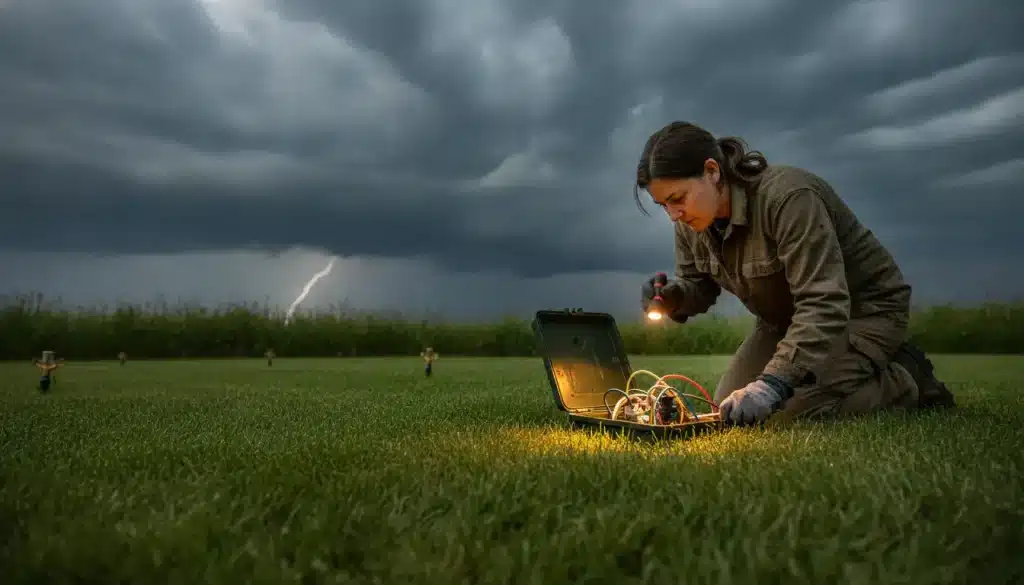
During a power failure, your sprinkler controller stops working, halting lawn watering until the issue is resolved.
Knowledge of irrigation system troubleshooting can help you resolve power outages that disrupt your sprinkler controller’s electrical operation. If you are a property owner who requires an effective irrigation system for your lawn or farm, especially if you are located in places like North Dallas, TX, and Collin County, reaching out to McKinney sprinkler system repair services will be useful, especially if the issue becomes too complicated to tackle without professional help.

Why a Power Outage Is Making Your Sprinkler Controller Not Turn On
A power failure may not be considered a major issue because power will eventually resume, but there are instances where it can cause the controller to fail to restart. Any power surge or fluctuation can affect the internal workings or override safety devices within the equipment.
Modern controllers have memory backup units that allow them to save schedules when the power goes down, and controllers with batteries or capacitors maintain settings. If these backups fail, the controller may lose its programming or refuse to start until power is restored.
If this occurs, do not assume the entire unit is broken. Firstly, one needs to determine whether the fault lies elsewhere in the irrigation system. The whole irrigation system isn’t dead just because the sprinkler controller doesn’t work.
Check These Basics Before Assuming the Controller Is Broken
To begin with, first attempt the basic solutions before trying to repair or replace the equipment.
- Make sure the outlet you have connected to the controller is fully receiving power.
- Check that the controller is properly connected and seated in the outlet.
- Lastly, you should check the electrical systems of your house for tripped breakers.
- Look for GFCI outlets that need to be reset following the power failure, as well.
- Check for corrosion around the outlet and on the controller itself.
In many cases, the problem is not the controller but simply a tripped breaker or a reset outlet.
In case the controller has battery backup, check its battery compartment. Should the electricity be restored and there be insufficient battery power, the scheduling will not work.
How to Troubleshoot a Sprinkler Controller That Won’t Turn On
Proceed to a more intricate procedure if the problem cannot be resolved with simple procedures. Try switching it off first, then back on. This is easy, but it might solve the problem. Some controllers need to be fully powered off and then back on for their electronics to reboot.
Next, check the display. If the screen is blank, there may be a problem with the irrigation system’s power source. Also, if strange symbols or lights appear on the device, it may indicate an internal system issue. Some systems will have a reset button in case of an interruption to the sprinkler system settings.
If the controller operates normally but there is no watering schedule in the system, you will need to enter the schedule, including the start time and duration for each zone.
It is also an ideal time to inspect the wires leading to the irrigation valves. Sometimes low-voltage wiring can be damaged, causing startup problems similar to those of a controller failure.
Common Electrical Issues That Can Cause Startup Failure
Problems arising from electrical issues following a blackout may not be as obvious as a blown fuse. Power surges usually damage the internal transformers, circuit boards, and external power adapters. Even a surge protector cannot protect against all damage caused by electrical power problems.
Loose wiring connections can also cause problems with power delivery after electrical fluctuations. Vibration, weather, or age might eventually loosen the terminals to the point that the controller cannot receive a consistent voltage.
When it comes to weather, in areas like North Dallas, TX, seasonal storms sometimes produce repeated outages that place additional stress on irrigation electronics. After extreme weather, property owners can perform routine system inspections to ensure the controllers, wiring, and valves are in good condition. In some instances, companies such as CitiTurf may recommend inspections after a storm because small electrical problems that could lead to sprinkler malfunctions are typically easy to fix before they cause malfunctions.
If there are any electrical issues, such as burnt components, one should stop troubleshooting and disconnect the system.
How to Restore Programming After the Controller Powers Back On
When your controller begins to function well again, be sure that you have good programming.
It is extremely important to verify the date and time settings so your programs run at the correct time.
Then review:
- Watering days for each irrigation zone
- Start times
- Zone run durations
- Seasonal adjustment settings
- Rain delay or weather sensor status
The newer controls can even back up your settings in the accompanying app or in the cloud, so you won’t have any issues reconfiguring after a grid power outage.
When DIY Troubleshooting Isn’t Enough
After all these steps have been taken and the controller remains completely unresponsive, it would be best to leave the diagnostics to the professionals.
The technicians will be able to test the incoming voltage, test the transformers, inspect the inside of the machine and its circuits, and decide whether repair or replacement is appropriate. They can also look for problems between the controller and field valves that homeowners may not be able to see.
In Conclusion
Despite proper maintenance of the irrigation system, a sudden blackout may temporarily cause the whole system to malfunction, but it doesn’t necessarily lead to a total system breakdown.
Basic electrical operations such as conducting electrical tests, checking the power source and programming, and running controller tests could be sufficient to rectify the situation without major repairs.
Have you had problems with the controller when the power has gone out, or have you found any tips for resolving these problems? Comment below.