
Contracts are everywhere. From a freelance agreement with a client to a commercial lease for your business, every binding document you sign carries legal weight you may not fully see until something goes wrong.
When it does, a contract attorney becomes one of the most important people in your corner.
If you are in Colorado and dealing with a contract dispute, trying to protect a business deal, or simply want to avoid costly legal mistakes before putting pen to paper, understanding how contract attorneys work is a smart first move.
This post breaks down everything from what they actually do day-to-day to what you will realistically pay for their services in this state.
What Does a Contract Attorney Actually Do?

Most people only think about hiring legal help after something has already gone sideways.
But a skilled contract attorney is far more valuable long before any dispute surfaces.
Their work covers the full lifecycle of a contract, from the moment an agreement is first drafted to the courtroom, if it ever gets there.
1. Drafting Contracts That Hold Up in Court
A contract written without legal oversight often looks perfectly reasonable until one party finds a loophole.
Contract attorneys draft agreements with precision, ensuring every obligation, timeline, penalty, and exit clause is defined in language courts can enforce.
Vague terms like “reasonable time” or “best efforts” can become serious liabilities when a deal sours, and a trained attorney knows exactly how to close those gaps before they open.
2. Reviewing Agreements Before You Sign
One of the most underused services a contract attorney offers is pre-signature review.
Before you commit to any significant agreement, having a legal professional read through the fine print can surface:
- Unenforceable clauses that could void the contract
- Terms that heavily favor the other party
- Missing protections you did not realize you needed
- Automatic renewal provisions buried in the back pages
- Liability caps that leave you exposed
This kind of review is often a flat-fee service and can cost a fraction of what a dispute will.
3. Negotiating Terms That Work in Your Favor
Contract attorneys also act as negotiators. If the other party’s terms are not acceptable, your attorney does not just flag problems.
They rewrite, propose counterterms, and communicate directly with opposing counsel to reach an agreement both sides can live with.
This is especially useful in business-to-business deals where both sides have legal representation, and the negotiating dynamics are complex.
Types of Contracts a Contract Law Attorney Handles in Colorado

The scope of contract law is broad, and most contract law attorneys in Colorado handle a wide range of agreements in both business and personal contexts.
1. Business and Commercial Contracts
From partnership agreements and operating agreements to vendor contracts and licensing deals, commercial contracts are among the most common types of work handled by a contract law attorney.
Colorado’s business environment, particularly in Denver, Boulder, and Colorado Springs, is active and competitive, so business owners often need airtight contracts to protect their interests.
Common business contract types include:
- Operating agreements for LLCs
- Shareholder and partnership agreements
- Vendor and supplier contracts
- Non-disclosure agreements (NDAs)
- Independent contractor agreements
- Franchise agreements
2. Employment and Non-Compete Agreements
Colorado has some of the most specific non-compete laws in the country.
Under HB22-1317, which significantly amended the state’s approach to restrictive covenants in 2022, non-compete clauses are now enforceable only for workers earning above a certain wage threshold and only in limited circumstances.
A contract law attorney familiar with Colorado employment law is essential when drafting or challenging these agreements.
3. Real Estate and Construction Contracts
Colorado’s real estate and construction sectors generate some of the most contract-heavy transactions you will encounter.
Whether you are a homeowner entering a contractor agreement or a developer working through a purchase contract, having legal representation during these deals is not optional; it is practical risk management.
4. Service and Vendor Agreements
Freelancers, consultants, and small businesses frequently operate on service agreements that were copied from a template or written informally.
These documents often lack the specificity needed to protect either party when deliverables are missed or payment is delayed.
A contract attorney can review or rewrite these agreements to incorporate clear remedies and dispute resolution procedures.
Understanding Breach of Contract in Colorado
Even the most carefully drafted contract can end in a dispute.
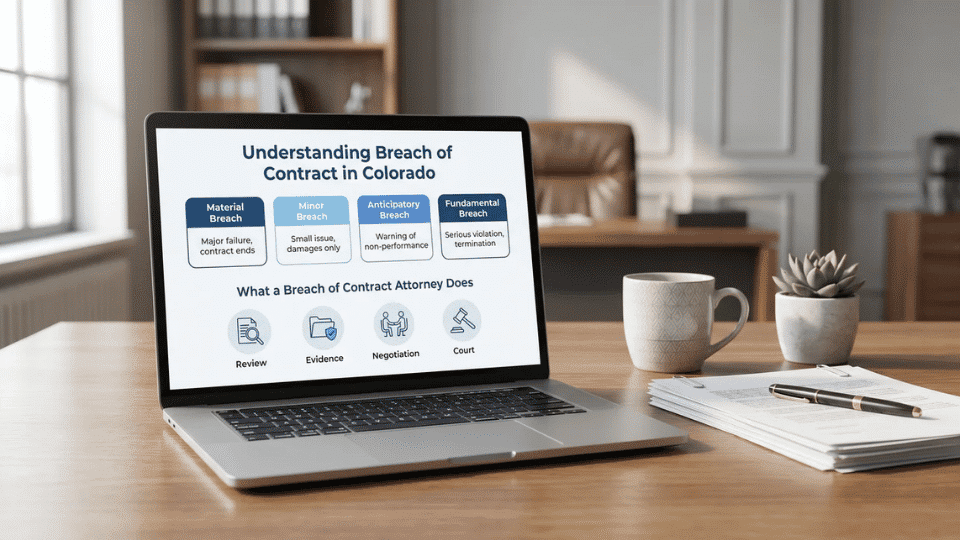
When one party fails to hold up their end of the bargain, you are dealing with a breach, and that is where a breach of contract attorney becomes essential.
The Four Types of Contract Breach
Not every breach carries the same weight in court. Understanding the category your situation falls into shapes what legal remedy you can pursue.
| Breach Type | What It Means | Potential Remedy |
|---|---|---|
| Material Breach | A major failure that defeats the purpose of the contract | Termination + compensatory damages |
| Minor Breach | A partial failure that does not void the contract | Damages for the specific shortfall |
| Anticipatory Breach | One party signals they will not fulfill obligations before the deadline | Immediate right to pursue legal action |
| Fundamental Breach | A severe violation that entitles the other party to terminate entirely | Termination + significant damages |
What a Breach of Contract Attorney Does for Your Case
When you hire a breach of contract attorney, they do not walk into court on day one. The process typically follows a sequence:
- Contract analysis: Your attorney reviews every clause of the agreement to establish what obligations existed and whether they were violated.
- Evidence gathering: Emails, invoices, communications, and performance records all become relevant.
- Negotiation and demand letters: Most disputes are resolved before litigation. Your attorney will attempt to reach a settlement first.
- Mediation or arbitration: Many Colorado contracts include dispute-resolution clauses that require parties to proceed through mediation or arbitration before a lawsuit can be filed.
- Litigation: If settlement fails, your attorney prepares and argues the case in court, seeking compensatory damages, specific performance, or contract rescission depending on the circumstances.
Colorado’s Statute of Limitations for Contract Disputes
Timing matters significantly in contract law. Under C.R.S. § 13-80-101, the general statute of limitations for breach of contract in Colorado is three years from the date the breach was discovered or reasonably should have been discovered.
There is one important exception: contracts involving a liquidated debt or an unliquidated but determinable amount are subject to a six-year limitations period.
For construction-related contract claims, the statute of limitations is shortened to 2 years under C.R.S. § 13-80-104.
Missing these deadlines means losing your right to sue regardless of how solid your case is, which is another reason not to delay consulting a breach of contract attorney.
Signs You Need to Hire a Contract Attorney Now
Knowing when to pick up the phone is often the difference between a manageable dispute and a costly, drawn-out legal battle.
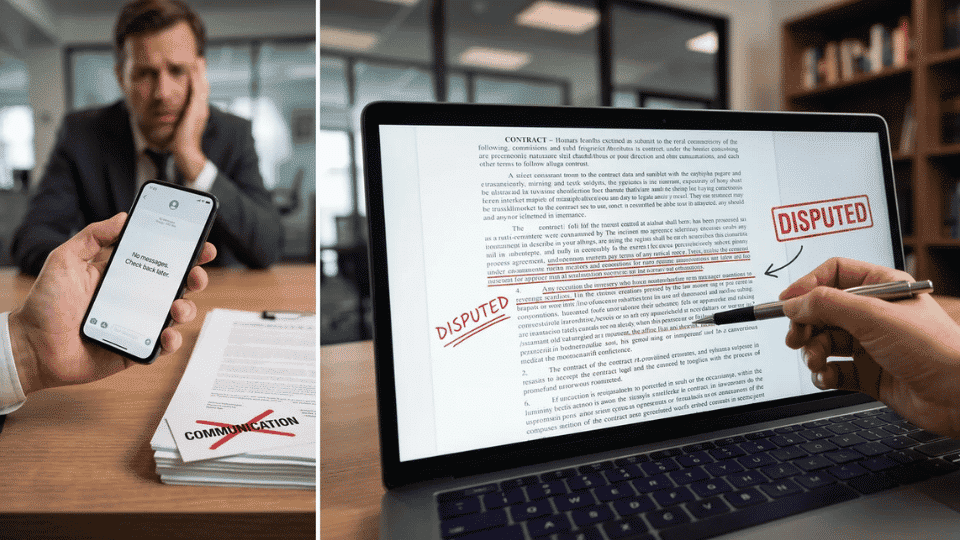
1. The Other Party Has Stopped Communicating
If the person or business you have a contract with has gone silent, stopped responding to emails, or is denying any wrongdoing without explanation.
This is a clear signal that informal resolution is off the table.
An attorney can issue a formal demand letter, which often prompts a response, or begin building the legal foundation for a claim.
2. Financial Stakes Are Too High to Handle Alone
When a contract dispute involves significant money, a long-term business relationship, or assets like real estate, the risk of handling it without legal counsel is simply too high.
Dense legal language, court procedures, and damage calculations are not areas where guesswork serves you well.
3. You Have Already Been Threatened With Litigation
If the other party has hired an attorney or sent you a legal notice, you should do the same without delay.
Going up against legal counsel without your own representation almost always puts you at a disadvantage, both in negotiations and in court.
4. The Contract Terms Are Unclear or Disputed
Sometimes the problem is not a clear failure to perform.
It is a genuine disagreement about what the contract actually required.
A contract attorney can analyze the language, research how Colorado courts have interpreted similar terms, and build an argument for your interpretation.
How Much Does a Contract Attorney Cost in Colorado?
Legal fees vary based on the complexity of the case, the attorney’s experience, and the location in Colorado.
Here is what current data suggests you can expect.
Hourly Rates vs. Flat Fees
| Service Type | Typical Cost Range in Colorado |
|---|---|
| Contract drafting (simple) | $500 to $1,500 flat fee |
| Contract review | $300 to $800 flat fee |
| Service agreement | ~$770 average flat fee |
| Business contract | ~$900 average flat fee |
| Construction agreement | ~$1,250 average flat fee |
| Attorney hourly rate (litigation) | $315 to $500+ per hour |
Data sourced from ContractsCounsel Colorado pricing data and Volpe Law LLC.
Retainers for Litigation vs. Document Review
For pre-litigation disputes and active court cases, most Colorado contract attorneys operate on an evergreen retainer model.
This means you deposit an amount into a client trust account that gets billed against as work proceeds.
Pre-litigation retainers in Colorado commonly start around $5,000, while active litigation matters typically require a minimum of $10,000 upfront.
For smaller tasks like a contract review or a single NDA, many attorneys offer flat-fee arrangements, and some provide a paid one-to two-hour consultation to assess your situation before you commit to full representation.
It is worth noting that a higher hourly rate does not always mean a higher total bill.
An experienced contract attorney who identifies the core issue early and resolves it efficiently can cost less overall than a less experienced attorney who takes longer to navigate the same terrain.
How to Choose the Right Contract Law Attorney in Colorado

With hundreds of attorneys licensed to practice in Colorado, narrowing down the right one for a contract matter requires more than a Google search.
1. Check Their Specific Experience in Contract Law
Contract law is a specialty, not just a checkbox on a general practice attorney’s list of services.
Look for attorneys who specifically list contract drafting, commercial agreements, or business litigation as their focus areas.
A contract law attorney with a track record in your type of dispute, whether that is employment agreements, real estate contracts, or vendor disputes, will bring more targeted knowledge than a generalist would.
2. Verify Their Colorado Bar License
Before you sign an engagement letter with any attorney, verify their license through the Colorado Supreme Court Attorney Search.
This takes less than two minutes and confirms the attorney is in good standing with no disciplinary history.
It sounds like a basic step, but it is one many people skip in the urgency of a situation.
3. Ask the Right Questions in Your First Consultation
Most contract attorneys in Colorado offer an initial consultation, either free or at a modest fee. Use it.
Come prepared with the contract in question, any related correspondence, and a clear summary of the issue. During that meeting, ask:
- Have you handled similar contract disputes in Colorado?
- What is your fee structure, and can you estimate the total cost?
- Who will actually be working on my case day-to-day?
- How do you approach disputes: do you try to settle first or go straight to litigation?
- What is a realistic outcome given the facts of my situation?
The answers will tell you a great deal about whether this attorney is the right fit.
4. Look Beyond the Firm’s Website
Check Google reviews, Avvo profiles, and Super Lawyers listings to get a fuller picture.
Peer recognition and client reviews together offer a more honest signal than any firm’s self-description.
Final Thoughts
A contract attorney is not just for when things fall apart.
The most valuable work they do often happens before any dispute arises, when a well-drafted agreement or a careful review prevents the problem entirely.
In Colorado, where contract law carries specific statutes, deadlines, and nuances around employment and construction agreements, working with an attorney who knows the local legal landscape makes a real difference.
Whether you need a contract attorney to draft a vendor agreement, a breach of contract attorney to recover damages from a failed deal, or a contract law attorney to protect your business from restrictive covenants.
The right legal support can significantly change your position.
Do not wait until the deadline is closing in or the other party has already hired counsel. The earlier you get a qualified contract attorney involved, the more options you have.
Frequently Asked Questions
What Are the 7 Rules of A Contract?
For a contract to be valid and recognized by the common law, it must include certain elements– offer, acceptance, consideration, intention to create legal relations, authority and capacity, and certainty.
What Not to Say in A Demand Letter?
Avoid threats of criminal prosecution, extortionate ultimatums (like threatening negative publicity to ruin a reputation), and highly emotional or insulting language.
Has Anyone Ever Won a Case by Representing Themselves?
Yes, people successfully represent themselves in court, but it is rare.