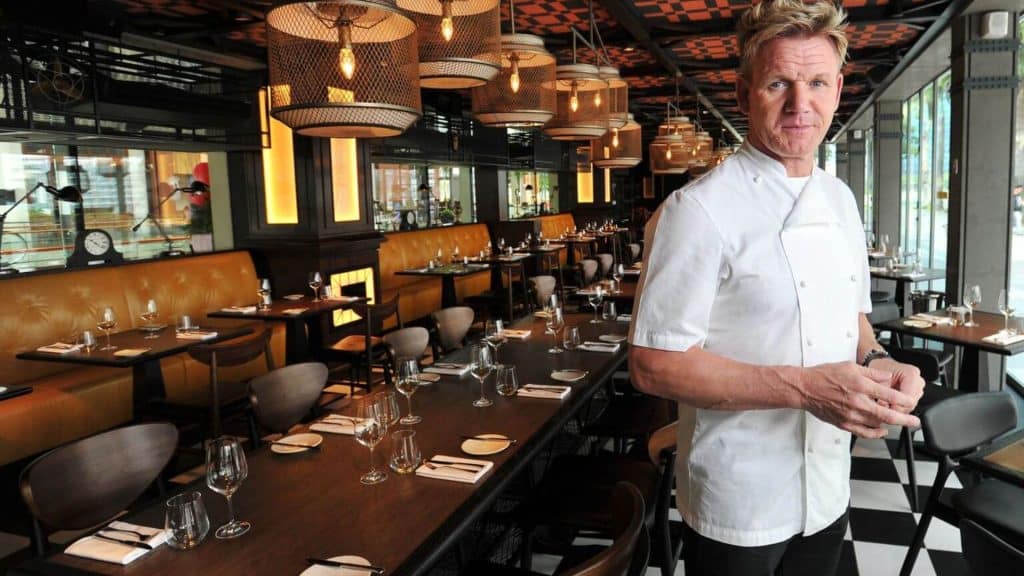
Gordon Ramsay built his reputation on being the best. Not approximately the best.
So when two Michelin stars were stripped from his New York restaurant in 2013, it didn’t just sting professionally.
It became one of the most talked-about culinary controversies of the decade. The story behind that loss is far more layered than a simple case of bad food.
It involves a sold restaurant, an absent chef, a kitchen without proper leadership, and a man who admits he cried when it happened.
To understand what went wrong, you need to understand just how much those stars meant to Ramsay in the first place.
How Gordon Ramsay Built His Michelin Star Empire
Gordon Ramsay earned his first Michelin stars at Aubergine in London, just three years after joining the restaurant in the mid-1990s.
That kind of speed was rare, and it set the tone for everything that followed. By the time he launched his flagship Restaurant Gordon Ramsay on Royal Hospital Road in Chelsea in 1998, the culinary world was watching closely.
In 2001, that restaurant was awarded three Michelin stars, a distinction it has held continuously ever since, making Ramsay the first Scottish chef to achieve that status.
Over the course of his career, Ramsay’s restaurant group, Gordon Ramsay Restaurants, has collectively earned 17 Michelin stars.
As of today, the group currently holds eight. Stars are not lifetime awards; they are reassessed annually by anonymous Michelin inspectors who dine at establishments without revealing their identity.
A single erratic meal, a stretch of inconsistency, or a slip in service can cost a restaurant its standing. It is a system built entirely on sustained excellence, not reputation.
This is the framework against which the 2013 loss must be understood.
The London NYC: From Triumph to Disaster

In 2006, Ramsay invested millions of his own money to open Gordon Ramsay at The London inside the luxury London hotel in Midtown Manhattan.
In 2008, the restaurant was awarded two Michelin stars, a remarkable achievement and Ramsay’s only Michelin-starred restaurant in the United States at the time.
But 2009 brought a significant change. Facing financial pressures, Ramsay sold the restaurant to The London hotel.
The establishment retained the Ramsay name under a licensing arrangement. Still, as a spokesperson confirmed at the time, Gordon Ramsay was not involved in the day-to-day running of the restaurants or kitchens.
Ramsay visited just a handful of times per year. For a stretch of that period, the restaurant did not even have a permanent Executive Chef, an extraordinary gap for any establishment trying to maintain a two-star rating.
The warning signs came early. About a year before the 2013 demotion, a Michelin reviewer posted on social media that their dinner at Gordon Ramsay at The London had not been their best experience. That tweet foreshadowed what was coming.
When the 2013 Michelin Guide was released, Gordon Ramsay at The London lost both of its stars. Michelin director Michael Ellis confirmed to Bloomberg that there had been significant instability at the restaurant and that inspectors had encountered very erratic meals there.
He emphasized that consistency is very important to Michelin.
According to Eater, it marked the first time any restaurant had ever lost two Michelin stars at once, a historic low for all the wrong reasons. The restaurant closed entirely later that same year.
The financial ripple effect of that moment was substantial.
Ramsay’s brand equity, restaurant licensing value, and media contracts, factors that put him ahead of Jamie Oliver financially, are all anchored to the perception of culinary prestige.
Losing Michelin stars, even for a restaurant he no longer ran, hit that positioning hard and shaped how carefully he manages his name to this day.
“I Started Crying” The Emotional and Personal Fallout
Ramsay has never pretended the loss didn’t hurt.
In a candid 2014 interview on the Scandinavian talk show Skavlan, he admitted he cried when the stars were taken and compared the experience to losing a girlfriend, someone you desperately want back.
That emotional admission is telling. For a man whose public persona is built on being unbreakable and exacting, the moment revealed just how deeply tied his identity is to culinary recognition.
The Michelin star is not a marketing tool for Ramsay; it is a validation of everything he sacrificed to build his career.
In 2019, he spoke publicly about chefs who voluntarily give back or reject Michelin stars, expressing genuine frustration.
He argued that a star is not just the chef’s achievement, but it belongs to every member of staff who worked for it. For Ramsay, losing stars is not just personal; it is a failure felt by every person in his kitchens.
What makes the 2013 loss even more complex is the question of accountability. Legally and contractually, Ramsay had sold the restaurant four years earlier.
The instability that followed the absence of leadership, erratic meals, and the lack of an executive chef under his control.
Yet because his name remained above the door, his reputation bore the full weight of the collapse.
It is a pattern that has followed Ramsay beyond the kitchen as well.
Even his first wife’s battles with her father, Chris Hutcheson, proved the same point: when your name is the brand, you wear the consequences of decisions you never made.
Conclusion
The London NYC debacle is ultimately a case study in what happens when a brand stretches beyond its operational control.
Ramsay’s name was still on the door, but the disciplined systems that earned the stars in the first place had long been dismantled after the 2009 sale.
Since then, Ramsay has been more deliberate about how his name is used. Restaurant Gordon Ramsay in Chelsea has maintained its three-star status uninterrupted since 2001.
Across his empire of more than 80 restaurants globally, his group currently holds eight active Michelin stars, cementing his place as one of the most decorated restaurant groups in the world.
The stars that were stripped were never truly his to lose by 2013, but the name above the door ensured he wore the consequences regardless.
In the world of Michelin, as Ramsay himself knows better than most, reputation doesn’t protect you from inconsistency. Only the food does.
Frequently Asked Questions
Why Would a Michelin Star Be Taken Away?
A restaurant could lose its star if it uses lower-quality ingredients, prepares dishes erratically, serves them poorly, or fails the maintain consistent taste.
Who Has 32 Michelin Stars?
Joël Robuchon, the late French “Chef of the Century,” held the record for the most Michelin stars ever.
What Is Gordon Ramsay Diagnosed With?
The 58-year-old revealed that he underwent surgery to remove basal cell carcinoma, the most common form of skin cancer.