
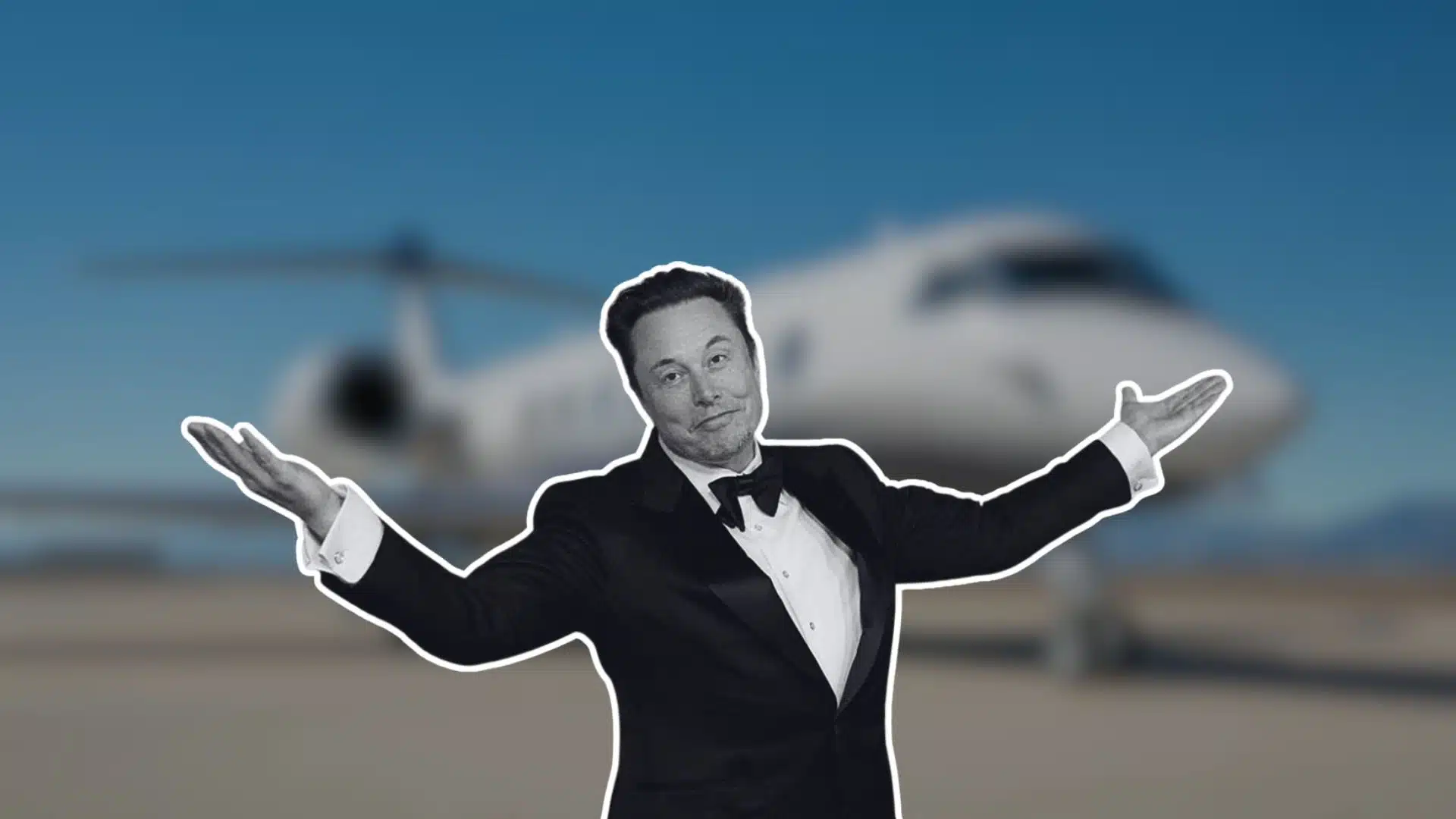
No private jet gets tracked, debated, or photographed more than Elon Musk’s. His primary aircraft, a Gulfstream G650ER registered as N628TS, has become a flashpoint for two of the loudest arguments in public life: billionaire privacy versus public accountability, and clean-energy messaging versus personal carbon emissions.
As the head of Tesla, SpaceX, and X, Musk logs hundreds of flights a year, moving between Gigafactories, launch pads, and political meetings. That travel record is public, trackable, and deeply contested.
This guide covers the full picture: his actual jet fleet, what the G650ER looks like inside, the real carbon numbers, how the ElonJet tracking account started, and how his aircraft compares to what other tech billionaires fly.
What Private Jet Does Elon Musk Use?
Musk’s primary jet is a Gulfstream G650ER, tail number N628TS, built in 2015 and in his fleet since April 2016.
It is owned through Falcon Landing LLC, a shell company registered in Hawthorne, California, near SpaceX headquarters. For most long-haul trips, including international travel and cross-country routes between Texas, California, and Florida, this is the jet he personally uses.
But the G650ER is not his only aircraft. Musk also operates two Gulfstream G550S. One, registered as N502SX and produced in 2003, is owned by Falcon Landing LLC and primarily operated by SpaceX for employee transport.
The second G550, registered as N272BG and built in 2007, is used by Musk for shorter trips and regional travel. Together, the three jets form a fleet sized for a CEO whose businesses span multiple time zones and no fixed headquarters.
Elon Musk’s G650 ER Specs and Performance

The G650ER is an extended-range variant of the standard Gulfstream G650, with 500 additional nautical miles added through a modified fuel system. Here are the key specifications for Musk’s primary aircraft:
| Feature | G650 Er (current) | G700 (potential) |
|---|---|---|
| Range | 7,500 Nm | 7,750 Nm |
| Max Speed | Mach 0.925 | Mach 0.925 |
| Passengers | Up to 18 | Up to 19 |
| Price | ~$70 M | ~$78 M |
The G650ER holds world records for speed and distance in business aviation, including the longest nonstop flight ever made by a purpose-built private jet: a Singapore-to-Las Vegas run covering more than 8,000 nautical miles.
For Musk’s routine routes between Austin, Los Angeles, and Cape Canaveral, the jet rarely approaches its range limit but benefits from its speed and the ability to skip refueling stops entirely.
|
How often does Musk actually fly? In 2024, both of Musk’s actively tracked jets logged a combined 355 flights, a drop from 456 the year before. The G650ER alone recorded 126 flights in 2024, burning over 150,000 gallons of aviation fuel. The busiest period coincided with political events in late 2024, with multiple Austin-to-West-Palm-Beach runs logged in November alone. The aircraft’s most-visited airports are Austin-Bergstrom International Airport (AUS), Jack Northrop Field in Hawthorne (HHR), and Brownsville-South Padre Island International Airport (BRO), near the SpaceX Starbase facility. |
Inside Elon Musk’s Private Jet Cabin

The Gulfstream G650 Er Interior Offers Luxury and Functionality Designed for Musk’s Demanding Work Schedule and Long-Distance Flights.
Sleeping and Relaxation
The cabin includes a private rear stateroom with a full bed that converts to seating during daytime hours. Blackout shades help maintain sleep schedules across time zones, a practical feature on transatlantic or cross-country overnight legs.
Onboard Amenities
The G650ER’s galley is fitted with warming ovens and full refrigeration. Two lavatories with premium fixtures are standard. Satellite internet and entertainment systems keep the cabin connected regardless of altitude.
Advanced sound dampening reduces cabin noise significantly compared to older business jets, a feature that matters on a three-hour flight when you’re running back-to-back calls.
Workspace and Conference Setup
A dedicated conference zone allows mid-flight business meetings, with adjustable seating configurations for up to six people at the dining table. Custom mood lighting adjusts to the time of day and can be controlled via touchscreens throughout the cabin.
The climate system uses separate zones to maintain consistent comfort across the full length of the aircraft.
The Elon Jet Tracking Controversy Explained
In 2020, a college student named Jack Sweeney created a Twitter bot called @ElonJet.
The account pulled publicly available ADS-B (Automatic Dependent Surveillance-Broadcast) data, the same transponder signals that commercial air traffic control uses, and posted every takeoff and landing from Musk’s registered jets.
By early 2022, the account had amassed over 500,000 followers.
Musk offered Sweeney $5,000 to shut the account down. Sweeney declined. After Musk acquired Twitter and rebranded it as X, the @ElonJet account was suspended from the platform in December 2022, along with several related tracking accounts. Musk cited personal safety concerns for his family as the reason.
Critics called it a powerful public figure using platform ownership to suppress public-interest information. The account subsequently moved to other platforms, including Threads and Mastodon, where it continued to operate using the same public FAA data.
Elon Musk’s Private Jet Environmental Impact and Criticism

The carbon math on Musk’s fleet is straightforward and unflattering. The G650ER alone generated close to 1,500 metric tons of CO2 in 2024 from 126 flights.
The G550, registered as N272BG, added roughly 1,200 metric tons over 107 flights in the same period. Combined, that exceeds the annual carbon footprint of around 230 average Americans.
The tension with Tesla’s mission is not lost on critics. Tesla’s entire brand positioning rests on accelerating the world’s shift away from fossil fuels.
Private aviation is one of the most carbon-intensive travel methods per passenger, and Musk’s fleet operates at a scale that makes the contradiction highly visible. Environmental groups and climate journalists have pointed to this gap repeatedly.
Musk has not publicly addressed the emissions question in any detailed way. His stated position centers on security rather than sustainability: he has argued that his public profile poses genuine safety risks, making commercial flying impractical.
Gulfstream has noted that its newer aircraft, including the G650 series, incorporate aerodynamic improvements and Rolls-Royce engines that reduce fuel burn compared to older large-cabin jets.
That is technically true, but it does not close the gap between Musk’s personal emissions and the public image of the companies he leads.
How Musk’s Jet Compares to Other Billionaires
Musk is not alone in his choice of aircraft. The Gulfstream G650ER is effectively the default jet for ultra-high-net-worth individuals who need genuine intercontinental range. Here is how his primary aircraft stacks up against peers:
| Owner | Aircraft Model | Estimated Value |
|---|---|---|
| Elon Musk | Gulfstream G650 Er | $70 Million |
| Jeff Bezos | Gulfstream G650ER + Gulfstream G700 + Dassault Falcon 7X | $65 Million |
| Bill Gates | Gulfstream G700 + Bombardier BD-700 | ~$80M (G700 alone) |
| Mark Zuckerberg | Gulfstream G650 | $60 Million |
Bezos actually runs a larger and more varied fleet than Musk, including a Pilatus PC-24 for short-haul and smaller-airport access. The PC-24 can reach over 21,000 airports worldwide, far more than any large Gulfstream.
Musk’s approach is different: a flagship long-range jet supported by older G550S for secondary trips and employee transport.
The G700: What’s Coming Next for Musk’s Fleet
Musk placed an order for a Gulfstream G700 in 2022. The aircraft, which lists at around $78 million and offers a slightly longer range than the G650ER at 7,750 nautical miles, also features five distinct living areas and a full en-suite shower in the grand suite.
Delivery was originally expected in 2023 but was delayed due to certification issues. As of early 2025, Gulfstream confirmed deliveries were proceeding under what it described as the most thorough certification process in the company’s history.
When the G700 arrives, it is expected to replace the G650ER as Musk’s primary long-haul aircraft.
Disclaimer: The Information Shared Here is Based on Publicly Available Sources and Current Estimates. This Content is for General Informational Purposes only And Should Not Be Taken as Exact or Official Data.
Wrapping Up
The Elon Musk private jet story is really three stories at once: a top-spec aircraft built for the demands of running multiple global companies, a public controversy over billionaire emissions versus clean-energy branding, and an ongoing debate about whether publicly available flight data constitutes surveillance or accountability journalism. None of those threads is going away.
If you want to understand how Musk operates, his jets are a surprisingly useful lens. The fleet is more practical than flashy. The G650ER replaced a G550 for long-haul range, not for a bigger entertainment system.
The G700 order follows the same logic. For more on how tech billionaires manage wealth, public image, and controversy, see our look at Elon Musk’s personal life and relationships or our breakdown of the richest celebrities by net worth.
Frequently Asked Questions
What is the Tail Number of Elon Musk’s Private Jet?
Musk’s primary Gulfstream G650ER is registered as N628TS. His G550 runs as N272BG. Both are owned through Falcon Landing LLC, a SpaceX-linked shell company in Hawthorne, California.
How many private jets does Elon Musk own?
As of 2025, Musk operates three jets: a Gulfstream G650ER and two G550s. A Gulfstream G700 was on order, awaiting delivery.
Can You Still Track Elon Musk’s Jet?
Yes. After @ElonJet was suspended from X in 2022, it moved to Mastodon and Threads. FlightAware and JetSpy also track his aircraft using public FAA data.
How Much CO2 Does Elon Musk’s Jet Produce?
In 2024, his G650ER produced roughly 1,500 metric tons of CO2. His G550 added around 1,200 metric tons. Combined output exceeded 2,700 metric tons for the year.
What is the Gulfstream G650ER worth?
A new G650ER lists between $66.5 million and $70 million. Musk’s 2016 aircraft with custom modifications is estimated at around $70 million.