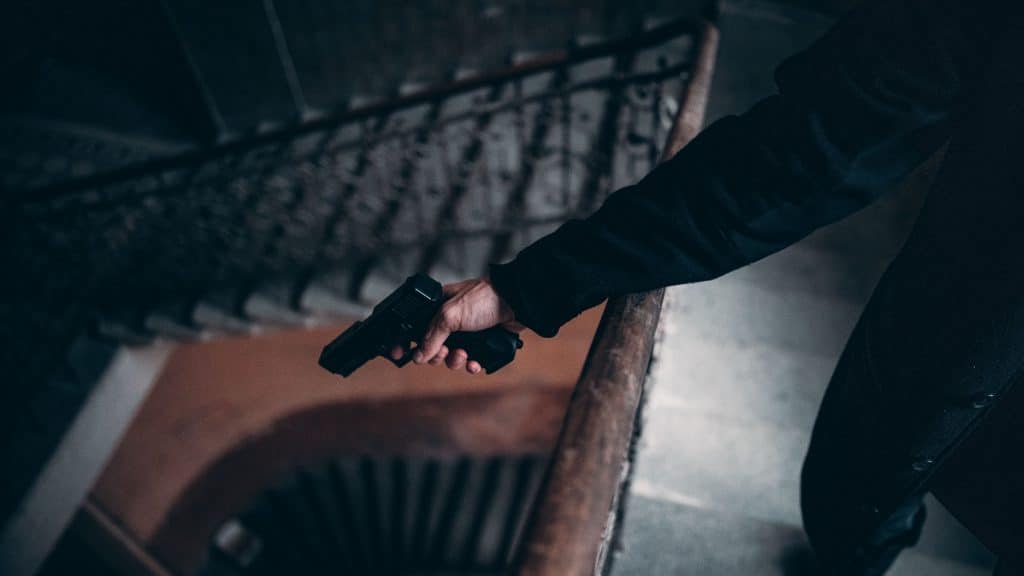
Pointing a firearm at another person is considered a crime almost anywhere in the country. But where exactly that lands depends heavily on where it happens.
Some states have a law written specifically for this act. Others fold it into broader assault, threats or weapons statutes instead. The offense itself, what prosecutors have to prove about your state of mind, and what you’re actually facing if convicted can look completely different from one state to the next.
That variation gets flattened in most writing on the subject. The flattened version is wrong in specific states, which is worse than useless to a reader in one of them.
The scale of this makes the distinction worth getting right. The FBI reported that firearms showed up in 32.8% of aggravated assaults in 2024, and aggravated assault made up 71.3% of all violent crime reported nationwide that year.
The Charge Travels Under Different Names
The charge does not have one universal name, and the legal consequences vary considerably by state. An analysis of whether pointing a firearm at someone is a criminal offense provides useful context for understanding how different jurisdictions approach conduct involving the pointing or aiming of a firearm.
Nevada doesn’t dance around it. Under NRS 202.290, willfully aiming any gun, pistol, revolver or other firearm at another person, loaded or not, is a gross misdemeanor. That can mean up to 364 days in jail and a $2,000 fine. It doesn’t matter whether you meant to scare anyone. Intent to frighten isn’t part of the equation, so the statute holds you strictly liable just for the act itself.
South Carolina takes a much harder line on the exact same conduct. There, it’s a felony, carrying a fine, up to five years in prison, or both. Same behavior, completely different world of consequences depending on which side of the state line it happens on.
Other states fold it into their broader assault laws instead of giving it its own name. Texas treats it as aggravated assault with a deadly weapon. It is considered a second-degree felony that can carry two to twenty years.
North Carolina takes yet another approach. They keep it a standalone charge on the books called assault by pointing a gun, classified as a Class A1 misdemeanor.
One Incident, Two Tracks
An accusation of this kind generates criminal exposure and civil exposure at the same time, and the two run on different burdens of proof. Firms like New London criminal defense lawyer John A. Collins, III, handle both sides of cases like this, from the criminal charge through any related civil exposure.
Loaded or Unloaded Rarely Decides It
The recurring assumption that an empty gun is a legal shield fails nearly everywhere. Nevada’s statute says loaded or not. So does North Carolina’s. Minnesota criminalizes reckless firearm handling without regard to whether the weapon holds ammunition.
The reason sits in what the statutes target. A person looking down a barrel cannot audit the chamber, and the fear runs identical either way.
Replicas Are Where the Statutes Actually Split
The rules regarding replicas have widely different standards, and many make mistakes upon.
Minnesota’s threats-of-violence statute reaches replica firearms and BB guns by name, defining a replica as a facsimile or toy version that reasonably appears to be a pistol, revolver, shotgun, rifle or other firearm. Brandishing one to cause fear is still chargeable.
North Carolina runs the other way. Its assault-by-pointing offense covers a gun or pistol, and the state Court of Appeals held in In re N.T. that an airsoft gun is not a gun for purposes of that statute. The UNC School of Government reads BB guns and air rifles the same way, since they fall outside the firearm definitions those charges rest on.
So you cannot claim that airsoft guns, pellet guns or water pistols fall under North Carolina’s pointing statute. The rule is jurisdictional, and the jurisdictions genuinely disagree.
Self-Defense Is Narrower Than Gun Owners Assume
Three elements do the work almost everywhere. The threat must be imminent rather than past or anticipated. The belief that force was needed must be reasonably measured against an outside observer, not merely sincerely held. And the force used must be proportional to what was faced.
The castle doctrine gets misstated constantly, usually by undercounting it. Effectively every state recognizes some version of it inside the home. What actually divides the states is whether the no-retreat rule extends past the doorway. Roughly twenty-nine have a stand-your-ground statute, about seven more arrive at the same place through case law, and a dozen or so still require retreat in public where retreat is safe.
Verbal aggression alone rarely clears the imminence bar. Shouting, unarmed and without physical advance, generally does not justify drawing a weapon.
The through-line is that the offense exists nearly everywhere, while its name, its grade, and its reach over imitation weapons differ hard between jurisdictions. Any summary written for a national audience will be wrong somewhere. The statute that governs is the one where the incident happened.