
Mike Tyson went to jail because an Indianapolis jury convicted him of raping Desiree Washington, a young pageant contestant, in his hotel room.
The judge handed down a long prison term, and good-behavior credit got him out after serving about half of the time that counted. He has denied the crime ever since.
That conviction is the main answer, but it wasn’t his only stay behind bars. A road-rage assault and a cocaine and DUI case followed.
Each case is set against the time he actually served, with dates and sources, and the page tracks what has happened since.
Why Did Mike Tyson Go to Jail: Charges and Convictions
Tyson has served three adult jail or prison terms. Besides the 1992 conviction, he served shorter terms for assaulting two motorists in Maryland and for a drug and DUI case in Arizona.
In the first two cases, he served far less than the sentence on paper, because of suspended years, good-behavior credit, and parole.
|
Case |
Sentence |
Time Served |
Share Served |
When |
|---|---|---|---|---|
|
10 years, last 4 suspended |
About 3 years |
About half of the 6 years left after the suspension |
Mar 1992 to Mar 1995 |
|
|
Two concurrent 2-year terms, all but 1 year suspended |
About 3.5 months |
Under a third of the 1 year left after the suspension |
Feb to May 1999 |
|
|
24 hours in jail |
Served in full |
All of it |
Nov 2007 |
1992 Rape Conviction
In 1991, Tyson was in Indianapolis for the Miss Black America pageant.
According to Washington’s account, he invited her to his hotel room and had her picked up by a limo, then assaulted her even though she said no.
An emergency room doctor later testified that she had abrasions consistent with forced or very hard intercourse.
The trial opened on January 27, 1992, before Judge Patricia Gifford. Tyson said it was consensual, but the jury didn’t buy it. On February 10, after about 10 hours of deliberation, they found him guilty of one count of rape and two counts of criminal deviate conduct. A confinement charge was dropped during the trial.
Criminal deviate conduct was the charge Indiana used at the time for nonconsensual sexual acts other than intercourse.
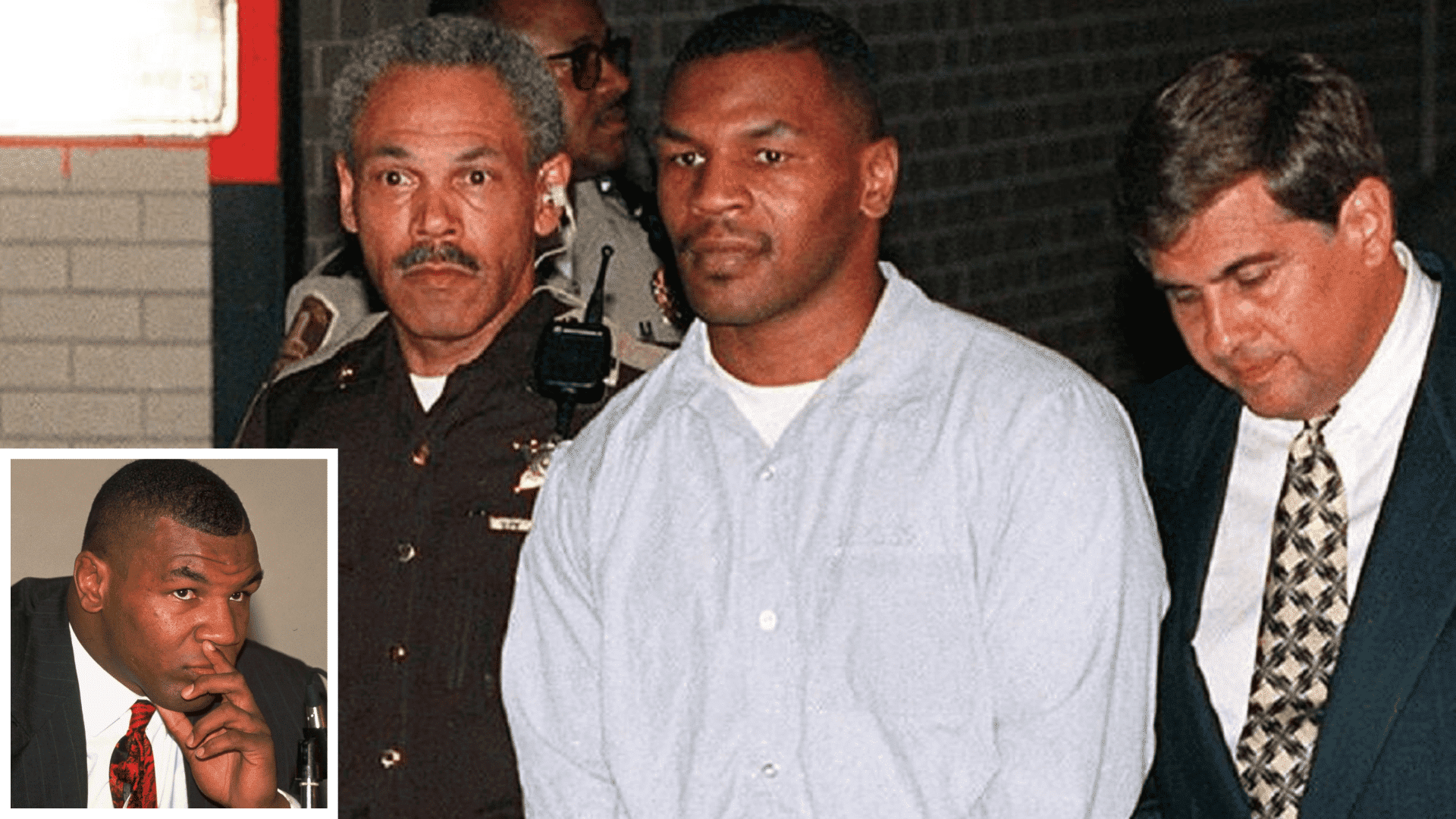
On March 26, 1992, he was sentenced to 10 years, with the final four suspended, so the maximum custodial term was six years. He was held at the Indiana Youth Center and released in March 1995 after about three years. Four years of probation followed, which means supervision outside prison.
This conviction hit hard. He was the youngest heavyweight champion in history, and it ended his career at its peak. His appeals did not overturn the conviction.
In his 2013 autobiography, Tyson argued that race played a part in his conviction, and he still says he’s innocent.
1998 Assault Case
The assault came while Tyson was still on probation from the rape conviction.
-
What Happened: In 1998, Tyson got into a road rage incident in Gaithersburg, Maryland. After a fender-bender, he punched and kicked two drivers.
-
Legal Outcome: Pleaded no contest to misdemeanor assault charges, which means he didn’t admit guilt but accepted the conviction. Both drivers settled out of court with Tyson and recommended that he not be imprisoned, but the judge still sent him to jail.
-
Sentence: On February 5, 1999, he received two concurrent two-year sentences with all but one year suspended, a $5,000 fine, and two years of probation. He also violated the terms of his 1992 probation, so 60 days were added. Judge Gifford in Indiana later agreed that the time he served in Maryland satisfied the penalty for that violation, and she ended the 1992 probation.
-
Time Served: Spent about three and a half months in Montgomery County Detention Center. He was paroled on May 21, 1999, and released on May 24.
2006 Drug and DUI Arrest
Cops in Scottsdale, Arizona, pulled Tyson over in December 2006 and found cocaine in his pocket and car. He admitted to using drugs whenever he could.
He pleaded guilty in September 2007 to felony cocaine possession, the more serious charge, and misdemeanor DUI. On November 19, 2007, he was sentenced to 24 hours in jail and three years of probation.
He served that time at Maricopa County’s Tent City jail.
Other Legal Matters
Beyond his jail and prison terms, Tyson has faced other legal trouble in his life.
Juvenile Arrests and Reform School
Tyson grew up in Brownsville, Brooklyn, and got into petty crime like pickpocketing as a boy. By age 13, he had been arrested 38 times, People magazine editor Larry Sutton said on CNN.
He was in and out of detention centers and ended up at the Tryon School for Boys, a reform school in upstate New York. There, counselor Bob Stewart, a former amateur boxing champion, agreed to teach him to box if he stayed out of trouble. Stewart later introduced him to boxing manager Cus D’Amato.
Boxing License Revoked
In 1997, the Nevada State Athletic Commission revoked his boxing license and fined him $3 million for biting Evander Holyfield’s ears during a fight. It was a sports penalty, not a criminal case.
Later Accusations and a Withdrawn Lawsuit
In 2001, San Bernardino County prosecutors said they didn’t have enough evidence to pursue rape charges against him. In 2002, the district attorney in Clark County, Nevada, declined to bring sexual assault charges over two other allegations.
A civil lawsuit filed in 2023 accused him of raping a woman in 1991. Tyson denied it, and she withdrew the case in March 2025.
Her lawyers said the dismissal was on procedural grounds. It never led to a conviction or a ruling against him.
Mike Tyson’s Life and Career After Prison
After his release from prison in 1995, Tyson returned to professional boxing and rebuilt his career. In 1996, he defeated Frank Bruno to win the WBC heavyweight title again. He continued fighting for several years before retiring in 2005.
Away from boxing, Tyson spoke openly about his struggles with alcohol and drug addiction. In a 2013 press conference, he described himself as a recovering alcoholic and said his past substance use had brought him close to death.
Tyson later returned to the ring for an exhibition fight against Roy Jones Jr. in November 2020. Four years later, he faced Jake Paul in a professional heavyweight bout on November 15, 2024. Paul won by unanimous decision after eight rounds. The judges scored the fight 80–72, 79–73, and 79–73.
His story also received renewed attention through Netflix’s four-part docuseries TYSON, which premiered on October 13, 2026
Boxing and Life After Prison
After his longest jail term in the 1990s, Tyson returned to boxing and won the WBC title again in 1996 by beating Frank Bruno. He kept fighting until he retired in 2005, then spoke openly about addiction.
At a 2013 press conference, he called himself a vicious alcoholic on the verge of dying.
Retirement didn’t stick. He came back for a 2020 exhibition against Roy Jones Jr. Then, on November 15, 2024, at 58, he lost to Jake Paul in an eight-round unanimous decision on Netflix, with scorecards of 80–72, 79–73, and 79–73. The streamer also premiered the four-part docuseries TYSON on October 13, 2026
Frequently Asked Questions
Did Mike Tyson Appeal His Rape Conviction?
Yes, and he lost. His lawyers argued the judge wrongly excluded witnesses and gave flawed jury instructions, but the appeals failed, and the conviction stood.
Is Mike Tyson a Registered Sex Offender?
Sex offender registration requirements and public listings vary by state and can change over time. For his current status, check the official registry of the relevant state.
How Much Prison Time Did Mike Tyson Face?
He was sentenced to 10 years with the last four suspended, so the maximum custodial term was six years. He served about three.
What Was Mike Tyson’s Time in Prison Like?
In 1994, a judge denied his parole request, noting that he had not acknowledged his conduct.
Where Things Stand
Mike Tyson’s legal history remains a major part of his public story, even decades after his first conviction.
His case also shows why it matters to distinguish confirmed court outcomes from accusations that never led to convictions.
Looking at the records gives readers a clearer understanding of his past without confusing separate legal matters.
What are your thoughts on Tyson’s legal history? Share them in the comments, and read about Cain Velasquez’s time in jail or Oscar Pistorius’ release.