Bill Clinton made waves in 1992 when he picked Al Gore as his running mate. Political experts questioned the choice.
Both men were young. Both came from neighboring Southern states. The pick broke every rule about balancing a ticket.
Why Bill Clinton picked Al Gore came down to three main factors. Clinton wanted foreign policy experience.
He valued Gore’s environmental leadership. Most importantly, he sought a true governing partner, not just an electoral asset.
The Unexpected Choice That Broke Tradition
On July 9, 1992, Bill Clinton announced Al Gore as his running mate. Both men were 40-something Democrats from the South. Clinton was 46. Gore was 44.
Traditional wisdom said tickets needed balance. A Northern candidate picked a Southerner. An older politician selected someone younger. The Clinton-Gore ticket ignored all these rules.
The media dubbed them the “Baby Boomer Ticket.” If elected, they would become the youngest team to enter the White House in American history. Gore called it “a new generation of leadership.”
Clinton wanted a genuine partner who could help him govern. This approach marked a turning point. After the Clinton-Gore campaign, candidates began prioritizing governing partnerships over geographic considerations.
Al Gore’s Congressional Experience
Gore brought serious credentials to the ticket. His congressional career began in 1976 when he won a House seat representing Tennessee.
He served for eight years, building a reputation for work in environmental and technology policy.
In 1984, Gore moved to the Senate. In 1990, he became the first candidate in modern history to win all 95 Tennessee counties. His Senate work focused on arms control, environmental legislation, and information technology.
Gore ran for president in 1988. He won more than three million votes and carried seven states. The experience gave him national recognition.
By 1992, Gore had 16 years in Congress. He understood Washington and had built bipartisan relationships. Gore’s military service also helped. He volunteered for the Army after Harvard and served in Vietnam.
Why Clinton Said He Chose Gore
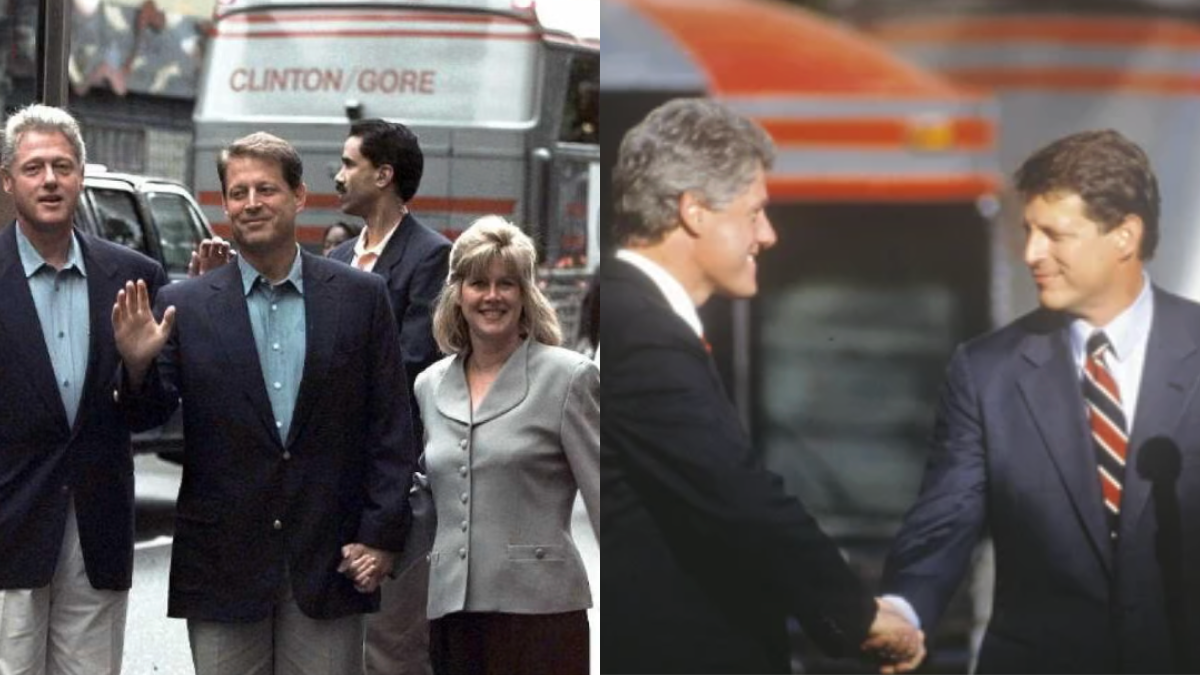
alt text: Clinton and Gore 1992 campaign bus tour with Hillary and Tipper
Clinton gave specific reasons for picking Gore. Foreign policy experience topped the list. Gore had worked on arms control in the Senate. As a governor, Clinton lacked these credentials.
Environmental leadership was another key factor. Gore had written “Earth in the Balance,” a bestselling book. He chaired the Senate delegation to the 1992 Earth Summit in Rio.
Clinton also valued Gore’s vision for technology. Gore had introduced the High Performance Computing Act in 1991. The legislation created a national high-speed computer network.
Personal character mattered too. In 1989, Gore’s young son nearly died in a car accident. Gore stepped back from politics to focus on his family. This impressed Clinton.
Warren Christopher led Clinton’s search team. They considered roughly 40 candidates. But Clinton kept returning to Gore.
The Political Strategy Behind the Pick
Clinton’s choice served clear strategic purposes. Republicans planned to paint Clinton as a “Northern liberal.” Picking a fellow Southerner blunted this attack.
Gore’s military service helped counter criticism of Clinton’s draft avoidance. Both men were moderate Democrats. They belonged to the Democratic Leadership Council, a centrist organization.
The Southern strategy mattered for electoral math. Republicans had dominated Southern states since the 1960s. Two Southerners gave Democrats a chance to compete.
The strategy worked. They carried Arkansas, Tennessee, Louisiana, Georgia, and Kentucky.
The famous bus tour sealed the deal. After the convention, the candidates traveled 1,000 miles by bus from New York to St. Louis.
How the Partnership Worked
Clinton and Gore were inaugurated on January 20, 1993. Gore became a genuine adviser, not just a ceremonial figure. He met with Clinton regularly and advised on appointments and policy.
Gore spent about a quarter of his time on foreign policy. Technology and the environment became his signature issues.
He championed internet expansion. The administration launched the first White House website on October 21, 1994.
Gore led the National Performance Review to improve government performance. About 80 percent of its recommendations were implemented.
The Clinton-Gore administration presided over strong economic growth. Unemployment fell. The budget moved into surplus. They won re-election easily in 1996, defeating Bob Dole and Jack Kemp.
Paul West of The Baltimore Sun wrote that “Al Gore revolutionized the way Vice Presidents are made.”
The 2000 Election and Personal Changes
Gore ran for president in 2000 against George W. Bush. The election came down to Florida. Gore won the national popular vote by more than 500,000 votes. But Florida’s 25 electoral votes would decide the winner.
What followed was 36 days of legal battles. The Florida Supreme Court ordered a statewide manual recount. On December 12, 2000, the U.S. Supreme Court halted the recount in a 5-4 decision. Gore conceded the next day.
The legal fight that led to his concession remains one of the most controversial moments in American electoral history.
Gore reinvented himself after leaving office. He focused on environmental activism and created “An Inconvenient Truth” in 2006.
In 2007, Gore won the Nobel Peace Prize for his climate change work. He became the second American vice president to receive the honor.
In June 2010, Gore and Tipper announced their separation after 40 years of marriage. They had four children together. Friends said they had simply grown apart. The separation came a decade after the 2000 election loss.
By 2012, both were dating other people but remained friendly. Gore continues his environmental work today. His romantic relationships have occasionally made headlines, though he keeps his personal life private.
Conclusion
Why Bill Clinton picked Al Gore came down to experience, expertise, and partnership. Clinton wanted foreign policy knowledge and environmental credibility. He found both in Gore.
The unconventional choice changed the vice presidential selection process. Gore became one of the most powerful vice presidents in history.
The partnership lasted through two successful terms, though both men’s paths diverged after 2000.
Clinton’s choice proved that picking the right partner matters more than following old rules.