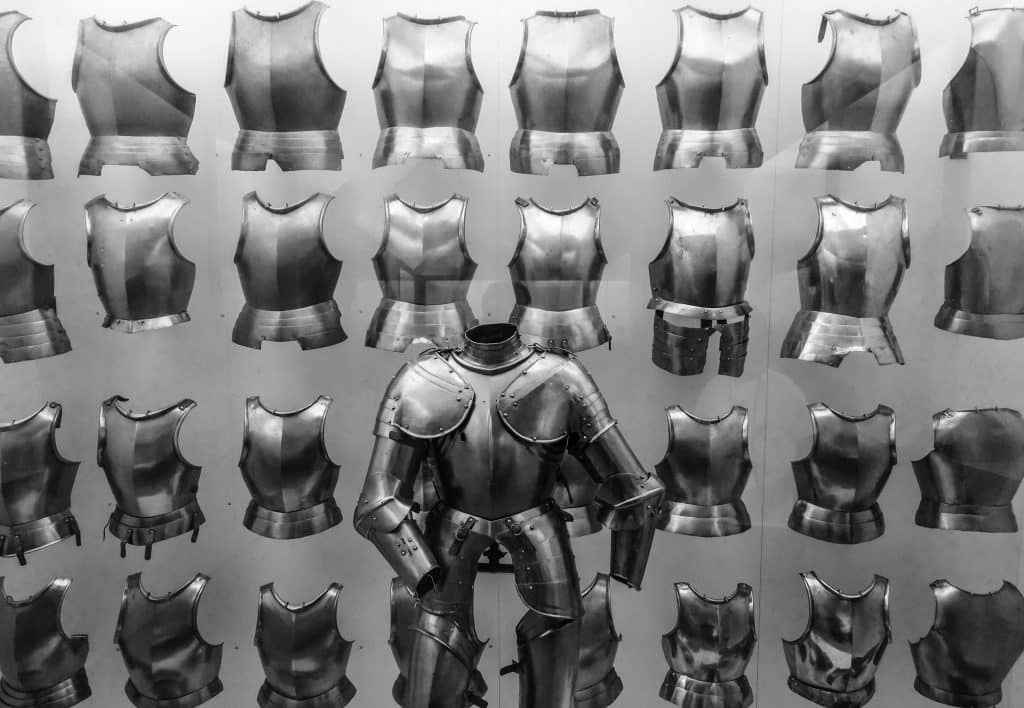
The 20th century saw medieval armour become property of museums and reenactment societies and academic projects which aimed to reconstruct historical elements. The design functioned to create interpretative outcomes which lacked practical use. The establishment of modern armored combat leagues created a new function for armored combat.
Historical armor already solved many engineering problems centuries ago. Late medieval plate harnesses were designed to distribute force across curved surfaces, deflect strikes, and preserve mobility for mounted and foot combat alike. Modern buhurt does not invent these principles because it proves them through competitive events. Designs undergo stress testing when fighters grapple and fall and collide with one another during athletic contests.
The main distinction between both systems exists in their different rates of development. Medieval armorers created better armor designs because they studied how different warfare methods changed across different combat periods. Modern armor workshops function through a continuous system which begins with their performance during tournament events.
Why historical inspiration is only the starting point
The need for authenticity still exists, but it has become less important than the need to achieve new goals. Archaeological accuracy establishes the basic form which includes body shapes and armor plate connections and movement patterns from existing armor collections. Buhurt creates battle situations which historical fighters never encountered because it combines extended team combat with fixed point evaluation and controlled combat times.
The research on medieval battlefield injuries demonstrates that historical armor designs were created for short combat situations which do not match the duration of modern tournaments that include multiple daily rounds. Fighters of today require solutions which enable them to maintain their performance throughout extended periods of time. Hardened spring steel and aviation-grade alloys provide better fatigue resistance, while modern padding systems decrease the chances of concussions. The original historical structure continues to exist, while the building process has undergone changes.
The field of biomechanics introduces a new development. Fighters in the present day engage in continuous training throughout the entire year which includes strength development and wrestling practice and intensive exercise sessions. Armor should enable athletes to perform their movements which require physical agility instead of providing them with protective security during ceremonial events.
What makes buhurt armour work in real competition
The competition process exposes all competitors’ hidden weaknesses at once. Equipment that appears to function correctly but actually fails to work properly vanishes from competitive leagues within a short time. Effective buhurt equipment balances three variables simultaneously: protection, mobility, and repeatability.
The different components of the system each fulfill their own separate functions which affect performance.
- Plate Arms and Pauldrons Bundle: Floating forearm rivets maintain rotational mobility during grappling while hardened spring steel plates protect biceps and elbows. The 50 cm pauldron coverage eliminates exposed gaps between torso armor and shoulder.
- Neck Protector for Armored Combat: Targets the seventh cervical vertebra, historically vulnerable even in period armor. Three overlapping plates create layered protection without restricting head movement, addressing one of the most documented injury risks in modern armored sport.
- Gambezone and Padded Chausses Set: Functions as the structural base of the armor system. Cotton and wool padding disperse impact energy while stabilizing attachment points for plate elements.
- Basic Floating Legs “Aurora”: Hardened steel legs with articulated poleyns allow running, pivoting, and takedown resistance. At roughly 6.17 kg, the system balances durability against mobility, essential during prolonged melees.
The successful buhurt armor system functions as a complete combat platform. Fighters do not assemble random historical pieces; they construct layered mechanical systems optimized for competitive survival.
Why safety and authenticity should not compete
People believe that safety improvements lead to historical accuracy loss because they hold this persistent misconception. The evidence demonstrates that the two concepts show the opposite relationship. The need for survival forced medieval armor to undergo constant development throughout time. Modern safety upgrades therefore continue, rather than betray, historical tradition.
The design of an effective armor system combines authentic design elements with protective features through specific technical measurements.
- Material thickness zoning: Thicker steel at impact hotspots such as helmet domes and knees, thinner plates where mobility matters.
- Articulated construction: Floating rivets and segmented plates preserving natural joint movement.
- Impact absorption layers: Padded liners reducing acceleration forces transferred to the skull and spine.
- Coverage continuity: Overlapping plates preventing exposure during extreme body positions.
- Weight distribution: Systems designed to transfer load across torso and shoulders rather than concentrating mass on joints.
The Padded Helmet Liner with Aventail demonstrates how invisible components determine real safety outcomes. The Multi-layer padding system prevents impulse transfer, and the modular aventail system protects neck and jaw areas during downward impacts.
Engineering decisions follow two guiding constraints which engineers must balance between their need for authentic designs and their requirement for safety. The best armor feels historically authentic because it provides effective protection.
How buyers can judge craftsmanship before ordering
The evaluation process of armor by experienced fighters follows the same method that engineers use to assess machinery because they first study the armor’s articulation points and material specifications and weight distribution before they evaluate its aesthetic appeal. The inquiry needs to determine how plates move when someone uses them while wearing the armor. The inquiry needs to determine whether the padding systems work with helmets and torso protection systems and whether the maker understands tournament realities rather than museum display standards. The choice protection equipment which engineers create for buhurt combat serves as a commitment to gear which can withstand actual damage.