To fake old-world charm in modern homes, anchor rooms with oversized statement furniture, layer in authentic historical artifacts, and mix contrasting materials.
Gen Z shows strong interest in vintage and retro interior styles, with industry experts attributing this to consumers’ desire for personal, character-filled spaces that new furniture often lacks.
The good news is that you do not need to spend years scouring European flea markets. Focused design choices can fake decades of character by next weekend.
#1 Go Big With Statement Furniture
Blank rooms often fall flat because nothing anchors the eye, leaving the space feeling temporary. The most effective way to disrupt this “builder-basic” feel is by introducing furniture with substantial scale.
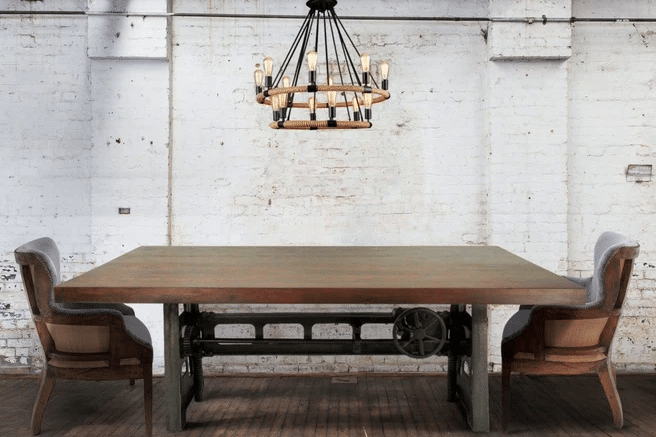
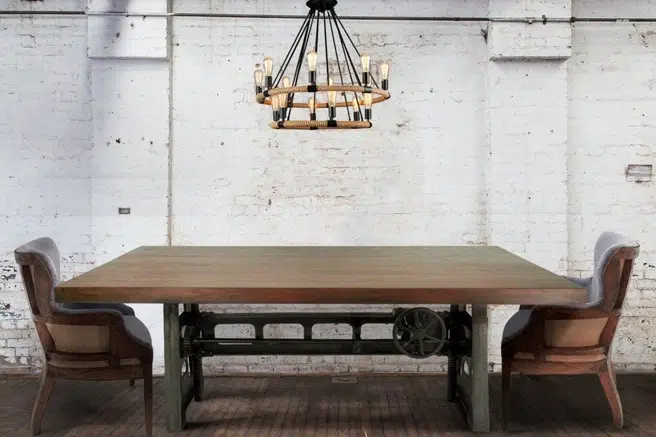
Designs like Knox Deco’s vintage-style industrial dining tables featuring cast-iron cranks suggest a 19th-century provenance. They marry practicality with a heavy, historical aesthetic.
Why it works
- Scale: Larger-than-average proportions hint at heirloom provenance rather than flat-pack convenience.
- Craft: Forged metal cranks and reclaimed timbers read as artisanal rather than mass-produced.
- Function: A conversation-starting mechanism invites guests to engage with the piece.
Styling tips
To maximize the impact, pair the hero piece with vintage schoolhouse chairs to create visual contrast. Suspending Edison-bulb pendants overhead echoes the style narrative without overpowering the room.
Ground the ensemble with a patterned kilim or worn Persian rug so the table feels “found.” Avoid over-accessorizing; one sizable earthenware jug is often enough.
Pro Tip: How to Source a Hero Piece
- Search estate auctions for oversized farm tables.
- Check architectural salvage yards for iron bases you can top with a live-edge slab.
- Use keywords like “crank,” “reclaimed,” and “industrial style” when browsing listings.
|
Key Insight: The fastest cure for a “builder-basic” room isn’t paint, but proportion. Oversized industrial pieces with visible mechanics immediately establish a sense of history that mass-produced, flat-pack furniture simply cannot replicate. |
|---|
#2 Layer In Authentic Historical Décor
Accessories are often where design themes go overboard. Instead of filling shelves with generic trinkets, select one high-impact historical artifact.
A polished helm or a suit of medieval armor from Medieval Collectibles brings instant gravity. This distinguishes a curated home from a showroom floor.
Emotional payoff
Placing one authentic item in a room triggers curiosity. People remember spaces that surprise them, and historical elements provide that disruption.
Display & care quick hits
- Mount heavy items on secure wall brackets rated for the specific weight.
- Keep humidity below 55 percent to prevent corrosion on metal items.
- Spotlight pieces softly from below to cast dramatic shadows.
Budget-friendly alternates
If you are not ready for chainmail in the foyer, antique maps or vintage botanical prints work well. These items achieve a similar “lived-in” narrative without the physical footprint.
Lean them casually against the wall rather than framing every piece. This avoids the look becoming too formal or museum-like.
|
Pro Tip: Prioritize one authentic artifact over a dozen reproductions. A single genuine piece, like a vintage helm or antique map, acts as a narrative anchor that invites curiosity and elevates the entire room’s perceived value. |
|---|
#3 Play With Mixed Materials for Texture & Depth
Mixed materials supply the subtext of a room, creating layers that read as “built over generations.” Any unexpected pairing of natural finishes helps break the uniformity that screams “new build.”
The reclaimed lumber market is experiencing strong growth, with residential applications, including home interior design, accounting for over half of total market demand. This growth is driven by increasing consumer preference for sustainable and aesthetically distinctive materials. This involves combining weathered timber, raw metals, and rough stone.
High-impact combos
- Weathered wood + blackened steel + aged leather
- Tumbled limestone + warm brass + woven jute
- Raw concrete + reclaimed oak + antique bronze
- Distressed terracotta + smoked glass + patinated copper
Where to find them
Flea markets are excellent sources for small-scale metals like old hardware. Architectural salvage yards offer reclaimed beams or iron brackets.
Online vintage marketplaces can also be goldmines. Set alerts for keywords like “hand-hewn,” “barnwood,” or “patinated.”
Sustainability bonus
Every salvaged joist or repurposed iron base helps keep quality materials out of landfills. Home builders are increasingly incorporating resource-efficient materials and practices amid rising demand for sustainable homes, with trends like energy-efficient designs and low-carbon materials driving market growth in 2026.
Quick Sourcing Tips
- Estate sales: Arrive on the final day for steep discounts.
- Reproduction specialists: Offer historically inspired shapes at a lower cost.
- Online Marketplaces: Use saved searches to get instant notifications.
- Community reuse centers: Ideal for bricks, wood flooring, and architectural doors.
|
Important: Avoid the “showroom trap” of matching finishes perfectly. Uniformity signals “new construction.” To fake age effectively, you must deliberately clash textures – pairing rough raw steel with warm, weathered wood or soft, aged leather. |
|---|
Your Next Steps
Old-world charm isn’t an all-or-nothing commitment. Start with one hero piece, like an industrial crank table or a single suit of armor.
Let supporting textures and accents evolve organically around that focal point. Anchor the room, weave in a story element, and finish with a tactile blend of materials.
Snap before-and-after photos as you go to track your progress. We’d love to see how you breathe fresh life and historical intrigue into modern walls.