To end costly project delays, secure reliable heavy equipment transport during pre-construction, and implement a preventive maintenance schedule. You must also establish a rapid aftermarket parts pipeline to eliminate downtime caused by logistics failures.
While weather and design changes often dominate headlines, veteran superintendents know the truth. The real schedule-killer is usually equipment stuck in transit or waiting for replacement parts.
The good news is that you can eliminate most of that downtime with three practical moves. None of these requires a sweeping overhaul of your current processes.
In the next few minutes, you will discover how to guarantee machines arrive exactly when scheduled. We will also cover a maintenance playbook that cuts surprise failures significantly. Master these strategies immediately. You will hold the keys to a true zero-downtime site.
Why Equipment Hiccups Ripple Across the Whole Job
Construction logistics is a domino game. When a wheel loader is late, the grade crew sits idle, and concrete trucks must reschedule.
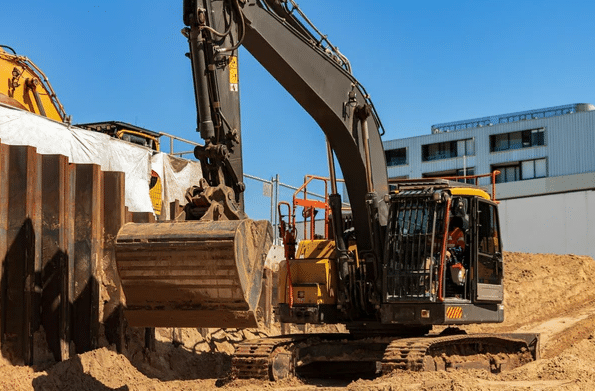
Meanwhile, every subcontractor on the critical path burns the budget just waiting. Take a mid-size excavator at $350 per hour, including operator and fuel. At eight hours of idle time, that equates to $2,800 a day. This does not even account for the crew clustered around it.
Multiply that across multiple machines over a nine-month schedule. Small lapses quickly balloon into six-figure overruns.
|
Key Insight: Equipment downtime isn’t an isolated cost; it triggers a domino effect. When one machine sits idle, every subcontractor on the critical path burns budget, turning small delays into six-figure overruns. |
|---|
#1 Reliable Heavy Equipment Transport
Problem
Permitting delays or wrong-sized trailers can freeze your critical path. A single missed permit can strand a dozer at a weigh station for days.
Impact
Every hour a machine sits on the highway is an hour crews cannot bill. Delays also trigger yard congestion when multiple late deliveries arrive at once.
Actionable Fix
- Lock in transport needs during pre-con: Treat route planning like any other milestone.
- Use carriers that specialize: Avoid generic brokers and look for providers who understand heavy equipment transport logistics like Titan Worldwide.
- Schedule “just-in-time” arrivals: A transport window of 12–24 hours prevents yard backups.
Expert Resource
For complex moves, utilizing a specialized network is essential. Top-tier providers maintain extensive driver networks and post high on-time rates across North America.
Their teams handle permitting and pilot cars for everything from excavators to wind-turbine blades. This offers a reliable solution when arrival dates must be iron-clad.
|
Important: Avoid generic freight brokers for heavy hauls. Without specialized knowledge of over-dimensional permits, a single missed document can strand your critical equipment at a weigh station for days. |
|---|
#2 Preventive Maintenance Planning
Problem
Reactive fixes are budget killers. By the time a hydraulic hose fails, you are already eating overtime.
Impact
Data shows that predictive maintenance can reduce equipment breakdowns or unexpected failures by up to 70-75 percent. Preventive maintenance, often combined with other strategies, supports reductions in unplanned downtime of up to 50 percent through optimized processes like spare parts management. Yet many crews still rely on gut feel or OEM hour-meter reminders.
Actionable Fix
- Implement digital tracking: Use a simple digital inspection checklist accessible via mobile phone.
- Tie service intervals to schedule phases: Complete services during planned rain delays.
- Stock critical consumables on-site: Keep filters and hoses that represent high-frequency failures ready.
Quick Wins (5-Minute Daily Walk-Around)
- Verify fluid levels and scan for leaks.
- Check tire or track tension.
- Inspect hydraulic lines at fittings and cylinders.
- Confirm all safety devices are functional.
Teams that adopt this routine catch failures before they strand a machine. This keeps construction logistics fluid and project efficiency high.
|
Key Insight: Industry data reveals a 5:1 ROI on preventive maintenance. By shifting from reactive fixes to schedule-tied service intervals, you can prevent up to 70% of mechanical failures before they stall your project. |
|---|
#3 Fast Parts Replacement
Problem
Even airtight PM plans cannot stop every seal blow-out. OEM lead times of three to seven days can idle an entire crew.
Impact
Contractors often lose thousands in labor fees during waits for simple hydraulic pumps. That is, before paying emergency freight to get the part on site.
Actionable Fix
- Establish a preferred-parts pipeline: Work with an aftermarket specialist for common machines.
- Maintain a shared spreadsheet: List part numbers and alternate SKUs to avoid research.
- Prioritize speed: Use vendors offering overnight options even if it costs more.
Expert Resource
When speed is critical, relying on specialized aftermarket suppliers can be a game-changer. Some vendors carry an extensive catalog of aftermarket parts and ship most orders the same day. HW Part Store’s heavy-duty Caterpillar loader parts offer a reliable solution with quick turnaround times.
Crews often report significant cost savings versus OEM. The primary value lies in parts arriving before the next shift starts.
|
Pro Tip: Don’t wait for a breakdown to source vendors. Build a “preferred-parts pipeline” now with aftermarket specialists who offer same-day shipping, bypassing the standard 3–7 day OEM lead times. |
|---|
The Compound Effect
Imagine a mid-rise build where a 55-ton excavator arrives late and a grader blows a hose. At average costs, that snowballs into massive losses.
Apply the three secrets instead to shave off the initial delay. PM prevents the engine failure, and your rapid parts pipeline turns outages into hiccups.
Total days lost drop significantly. This keeps subcontractors lined up rather than litigating delay clauses.
|
Quote: Veteran superintendents know the silent schedule-killer is usually equipment stuck in transit or waiting for parts. Mastering uptime strategies is the only way to guarantee a zero-downtime site. |
|---|
Success Snapshot
A civil contractor recently combined these tactics on a roadway expansion. They partnered with reliable transport logistics and digitized inspections.
Sourcing seal kits through a rapid aftermarket supplier resulted in minimal downtime. They achieved an 82 percent reduction from their prior baseline.
Making It Happen
- Secret #1: Book reliable heavy-haul early and track arrivals in real time.
- Secret #2: Sync preventive maintenance with your schedule.
- Secret #3: Build a same-day pipeline for the parts that fail most often.
The projects that dominate 2025 will be the ones that master equipment uptime. Start putting these secrets to work on your jobsite now.