

Buying night vision goggles can be confusing the first time.
Specs sound technical. Product listings exaggerate performance. And prices range from a few hundred dollars to several thousand.
Before you buy anything, stop and ask a few basic questions. The answers will tell you whether a device fits your needs or wastes your money.
This checklist walks through the ten questions experienced buyers ask before purchasing night vision gear.
What Are Night Vision Goggles?
Night vision goggles are optical devices that help you see in low-light or near-dark conditions.
They work by amplifying small amounts of light. Moonlight, starlight, or distant streetlights get intensified so the human eye can see the scene.
Inside the device is a component called an image intensifier tube. It converts faint light into a brighter image that appears green or white through the eyepiece.
People use night vision goggles for things like:
- wildlife observation
- hunting
- security patrols
- search and rescue
- navigation in dark terrain
But not all devices work the same. Some are high-quality tools. Others are cheap digital cameras with infrared lights.
That’s why asking the right questions matters.
How Night Vision Goggles Actually Work
Traditional night vision uses an image intensifier tube.
Here is the basic process:
- The lens collects small amounts of available light.
- A photocathode converts that light into electrons.
- The electrons are multiplied inside the tube.
- A phosphor screen turns those electrons back into a visible image.
The result is a brighter picture that lets you see in the dark.
Some devices also include infrared illuminators, which act like invisible flashlights when natural light is too low.
First-Time Buyer’s Checklist: 10 Questions to Ask Before Buying Night Vision Goggles
1. What Generation Is the Night Vision?
Night vision is usually categorized by generation.
Each generation reflects improvements in image clarity and performance.
Gen 1
- cheapest
- short viewing distance
- heavy image distortion
Gen 2
- clearer images
- better light amplification
- common for civilian use
Gen 3
- excellent performance in very low light
- used by the military and law enforcement
- much more expensive
Some sellers mention Gen 4, but that term is debated in the industry and often used loosely in marketing.
For most beginners, Gen 2 offers the best balance of price and performance.
2. What Is the Image Resolution?
Resolution determines how sharp the image looks.
In traditional night vision, resolution is often measured in line pairs per millimeter (lp/mm).
Higher numbers mean clearer detail.
Low resolution makes it hard to identify objects or see movement at a distance. For beginners, clarity is more important than extra features.
If possible, look through the device before buying. Specs alone don’t always tell the full story.
3. What Magnification Do You Actually Need?
Many beginners assume higher magnification is better.
But high magnification can make night vision harder to use.
Most goggles are designed with 1× magnification. That allows natural movement and better depth perception.
Higher magnification can narrow the field of view, making navigation difficult.
If your goal is walking, scouting, or observing wildlife, lower magnification is usually better.
4. What Field of View Does the Device Have?
The field of view (FOV) describes the extent of the visible area.
A wider field of view makes it easier to detect movement and navigate terrain.
Typical night vision goggles offer about 40 degrees of field of view.
Narrow fields of view can feel like looking through a tunnel, making it harder to move around at night.
5. Is It a Monocular or Binocular System?
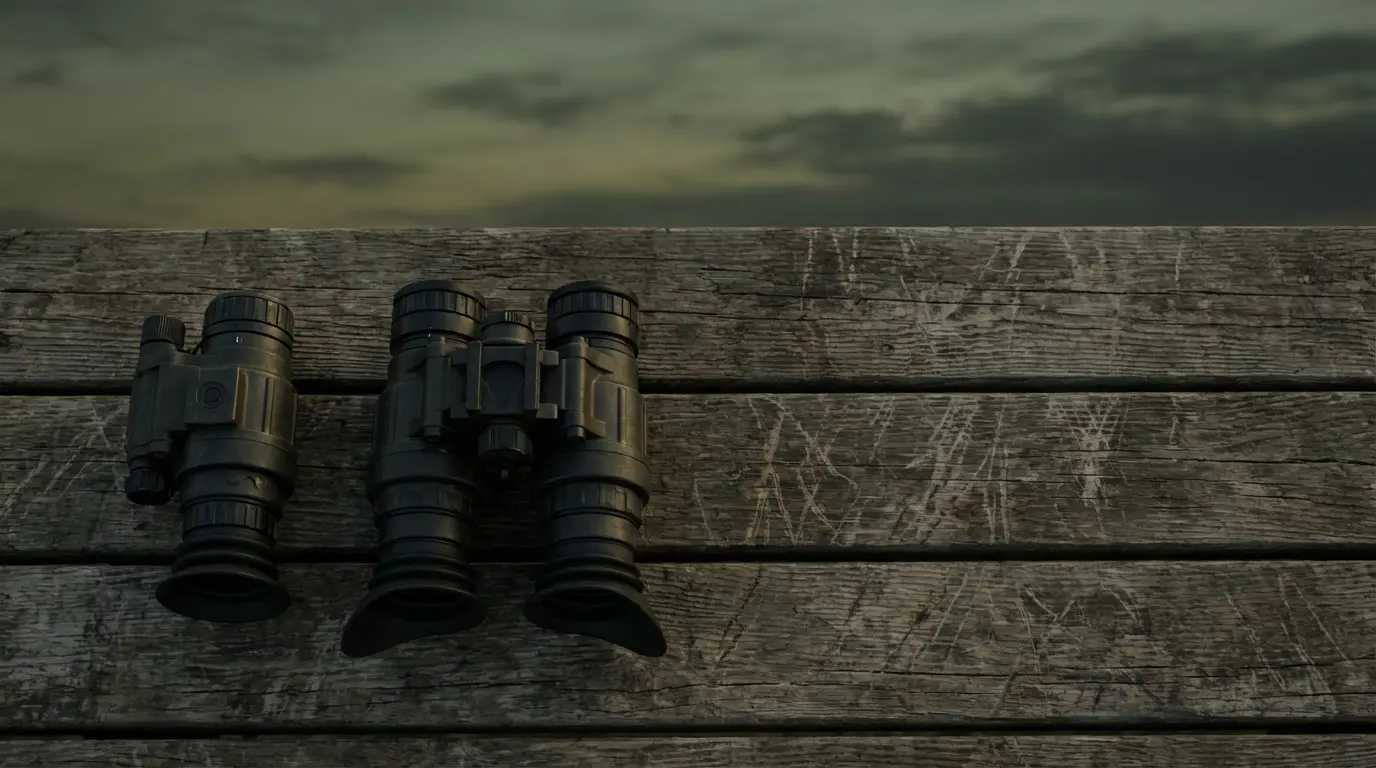
Night vision devices come in several formats.
Monocular
- one viewing tube
- lightweight
- commonly used by beginners
Binocular
- two tubes
- better depth perception
- more expensive
Panoramic or quad-tube
- very wide field of view
- extremely expensive
- mostly used in specialized military applications
Many first-time buyers start with a monocular, then upgrade later if needed.
6. How Long Does the Battery Last?
Battery life is often overlooked.
Some devices last only a few hours. Others can run all night.
Check:
- battery type
- average runtime
- Whether spare batteries are easy to carry
If you plan long outdoor trips, battery life becomes important quickly.
7. Does It Have an Infrared Illuminator?
Night vision depends on available light.
But sometimes there is almost none.
That’s where an infrared (IR) illuminator helps. It projects invisible infrared light that night vision devices can detect.
Think of it as a flashlight that only night vision can see.
But keep in mind:
IR illumination can sometimes be detected by other night vision users.
8. Is the Device Durable?
Night vision gear is used outdoors. It needs to survive rough conditions.
Look for features such as:
- waterproof or water-resistant housing
- shock protection
- sealed optics
- sturdy materials
Cheap plastic units often fail after limited use.
Durability matters more than cosmetic design.
9. Are There Legal Restrictions?
In the United States, civilians can legally own most night vision devices.
But there are export restrictions.
High-end night vision equipment falls under ITAR regulations. That means exporting or transferring certain devices outside the U.S. can be illegal without proper authorization.
If you buy night vision equipment, avoid shipping it internationally unless you understand the rules.
10. Where Should You Buy Night Vision Goggles?
Counterfeit night vision gear exists, especially online. If you’re researching night vision goggles for sale, start with reputable optics dealers that specialize in night vision equipment.
A good seller will:
- explain specifications clearly
- provide manufacturer documentation
- offer warranties and return policies
- allow testing when possible
If a deal looks unusually cheap, there is usually a reason.
Common Mistakes First-Time Buyers Make
Many beginners make the same mistakes.
Buying Based Only on Price
Cheap night vision often performs poorly.
Confusing Digital Night Vision With Traditional Night Vision
Digital models use cameras and infrared light. They work differently and often have shorter viewing ranges.
Ignoring Comfort
Heavy devices become uncomfortable after long use.
Focusing on Extreme Specs
High magnification or complicated features don’t help if the image quality is poor.
Final Thoughts
Night vision goggles can be useful tools. But they are also expensive, and the market is full of exaggerated claims.
The best approach is simple.
Before buying, ask:
- What generation is it?
- Is the image clear?
- Is it comfortable to use?
- Does it fit my real needs?
If the answers make sense, you are probably looking at a device worth considering.
If not, keep looking.
A careful purchase now will save money and frustration later.